China’s Quartz Glass Products market spans fused-silica tubes, rods, plates, crucibles, and custom components. A polished catalog can look convincing. The harder test is whether a supplier can hold tight dimensions, explain material grades, and provide traceable inspection records. Small details matter: a clean tube end, consistent wall thickness, and packaging that prevents scratches during transit.
This guide compares suppliers through practical criteria, including manufacturing capability, product range, customization, quality controls, and communication. It also considers whether companies explain limits clearly. Quartz glass is not one-size-fits-all. A component suitable for a laboratory furnace may not meet the demands of semiconductor processing or optical use. Buyers should check specifications against operating temperature, purity needs, thermal shock, and intended application. Ask for drawings and test data. Then review them carefully.
A useful reminder comes from physicist Richard Feynman: “The first principle is that you must not fool yourself—and you are the easiest person to fool.” Feynman was not a quartz-glass industry specialist, so this is not a product recommendation. It is a sound rule for supplier research: verify claims rather than relying on presentation alone. Some information may remain unclear. That deserves a follow-up, not an assumption. The following overview helps readers identify credible Chinese suppliers and prepare more focused questions before requesting samples or quotations.
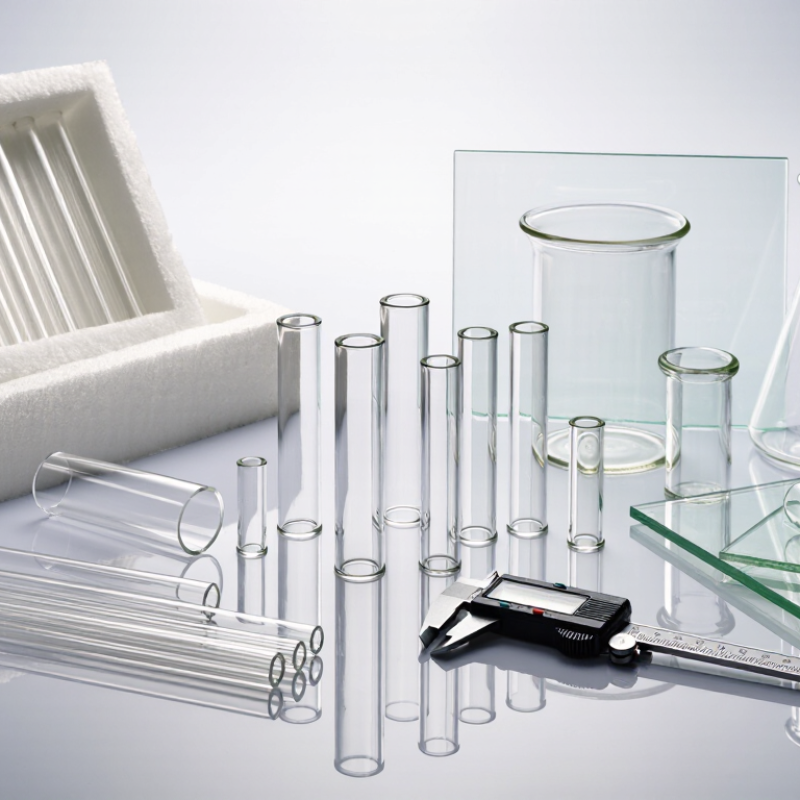
What Are Quartz Glass Products and Their Main Applications?
Quartz glass, also called fused silica, is made by melting high-purity silica and cooling it into a glass with very low thermal expansion. Suppliers commonly shape it into tubes, rods, plates, crucibles, and optical windows. These parts tolerate rapid temperature changes better than ordinary glass. They also offer strong chemical resistance and useful ultraviolet transmission, though performance depends on grade, surface finish, and operating conditions. Details matter.
Its applications are practical and varied. Semiconductor equipment uses quartz tubes and carriers in high-temperature processes, where contamination control is critical. Laboratories use vessels and reaction tubes for heating corrosive samples. Optical systems use selected grades for ultraviolet light paths, while solar manufacturing may use quartz components in furnace equipment. The U.S. Geological Survey’s Mineral Commodity Summaries 2024 estimated U.S. industrial sand and gravel production at about 96 million metric tons in 2023. That figure describes a broad silica feedstock, not quartz glass output; confusing the two can distort market comparisons. For buyers, checking purity, dimensions, thermal limits, and test documentation is more useful than relying on a generic “high-temperature” claim. One caveat: custom parts may behave differently after machining or repeated thermal cycling.
| Who Are the Top Quartz Glass Products Suppliers in China? - What Are Quartz Glass Products and Their Main Applications? | ||||
|---|---|---|---|---|
| Quartz Glass Product | What It Is | Typical Applications | Relevant Supplier Capabilities | What Buyers Should Check |
| Quartz tubing and pipes | Hollow components made from fused silica, an amorphous form of high-purity silicon dioxide (SiO₂). Tubing is available in different diameters, wall thicknesses, and grades. | Laboratory and industrial furnaces, chemical-processing equipment, thermal systems, and protective sleeves for sensors or heating elements. | Manufacturers of drawn or formed tubing, with options for cutting, bending, flaring, and end finishing. | Confirm outside and inside diameter tolerances, wall thickness, straightness, surface quality, and compatibility with the operating environment. |
| Quartz plates, windows, and discs | Flat or shaped fused-silica components. Optical transmission varies with material grade, wavelength, thickness, and surface finish. | Optical windows, laboratory instruments, semiconductor equipment, and sight glasses in high-temperature processes. | Suppliers able to cut, grind, polish, drill, or fabricate parts to drawings, with optical-grade options where required. | Specify dimensions, flatness, parallelism, surface quality, wavelength range, and any required inspection documentation. |
| Quartz rods and bars | Solid fused-silica stock supplied in round, square, or custom profiles for machining or further fabrication. | Laboratory components, furnace fixtures, support parts, and custom electrical or optical assemblies. | Stock-shape suppliers and fabricators offering cutting, grinding, and machining to customer specifications. | Check grade, dimensions, straightness, surface condition, and whether the part is supplied as stock or finished to drawing. |
| Quartz crucibles | Vessels made from fused silica in sizes and designs suited to high-temperature material processing. | Crystal-growth processes, including the Czochralski method used to grow silicon crystals, as well as other specialized melting operations. | Specialist crucible producers able to control geometry, material consistency, and production quality for the intended process. | Verify dimensions, purity requirements, intended process conditions, handling guidance, and lot-specific quality records. |
| Quartz boats, trays, and carriers | Custom or standard holders fabricated from quartz glass for transporting or supporting components during thermal processing. | Semiconductor and electronics processing, laboratory furnaces, and other applications requiring clean, heat-resistant carriers. | Fabricators with precision forming, welding, machining, and cleaning processes for application-specific geometries. | Review drawing tolerances, load and temperature conditions, cleanliness requirements, weld quality, and replacement availability. |
| Quartz chambers and custom process parts | Fabricated tubes, chambers, manifolds, and other components designed for a specific equipment or process configuration. | Thermal processing equipment, chemical or laboratory systems, and selected semiconductor manufacturing tools. | Engineering-focused suppliers able to work from drawings or specifications and provide forming, joining, and dimensional inspection. | Confirm the design, operating atmosphere, thermal cycling, connection details, leak or pressure requirements, and inspection criteria. |
| Quartz lamps and lamp envelopes | Quartz-glass envelopes used in certain lamps because the material can withstand high operating temperatures and transmit relevant portions of the light spectrum, depending on grade. | Specialized heating, curing, laboratory, and lighting equipment. | Suppliers of lamp-grade quartz components or complete lamp assemblies, depending on the purchasing requirement. | Specify lamp type, dimensions, operating conditions, electrical requirements for complete assemblies, and applicable safety standards. |
| Supplier selection across product categories | Chinese suppliers may specialize in raw quartz-glass stock, standard products, custom fabrication, or complete assemblies; capabilities differ by producer. | Suitable supplier choice depends on the application, required grade, geometry, production volume, and quality documentation. | Compare technical support, fabrication range, production capacity, quality controls, export experience, and ability to meet the required specification. | Request drawings, material and inspection specifications, samples where appropriate, lead times, and written confirmation of application-specific requirements. This table does not rank or endorse individual suppliers. |
| Reference properties of fused silica | Representative properties often quoted for fused silica include a density of about 2.2 g/cm³, a refractive index near 1.46 at the sodium D line, and a very low coefficient of thermal expansion of roughly 0.5 × 10⁻⁶/K over a commonly cited temperature interval. | These properties help explain its use in optical, laboratory, and high-temperature components. | Suppliers should identify the material grade and provide property data relevant to the specific product and application. | Values are indicative, not a substitute for a grade-specific datasheet. Properties and performance vary with composition, manufacturing method, wavelength, temperature, and product geometry. |
| Note: Quartz glass is commonly used to mean fused silica. Product suitability depends on grade, design, manufacturing quality, and operating conditions; buyers should confirm specifications directly with the supplier. | ||||
FAQS
Match the supplier’s capabilities to your application, such as furnace tubes, optical parts, or laboratory ware. Ask for batch records on purity, bubbles, inclusions, and dimensions. A polished sample is only one clue.
Request material certificates, dimensional reports, and written tolerance limits. Ask which checks cover every part and which use sampling. Details matter.
Check its clarity, edge finish, bubbles, and fit against your drawing. A sample can reveal issues early, but it cannot prove batch consistency.
Provide purity, dimensions, wall thickness, operating temperature, and chemical exposure. Use the same specifications for every supplier. Small omissions can cause costly confusion.
No. Compare lead times, minimum order quantities, packaging, inspection methods, and defect handling. A low quote may hide unclear inspection practices.
It can show whether actual parts meet the drawing and whether communication stays clear. Track defects and schedule changes. It takes extra time.
No. A December 2024 forecast estimated global equipment sales at $113 billion for 2024 and $121 billion for 2025. It did not measure quartz glass sales directly.
No. Check how machining, cleaning, inspection, and packaging stay consistent across batches. Even a careful audit can miss something; the checklist may need revision.
Conclusion
Quartz Glass Products are valued for their purity, heat resistance, and ability to perform reliably in demanding environments. They are used in areas such as semiconductor manufacturing, optics, laboratory equipment, lighting, and other industrial processes. China’s supply industry includes producers focused on raw materials, custom fabrication, and finished components, giving buyers options ranging from standard items to application-specific designs.
When comparing suppliers, buyers should consider product quality, material consistency, processing capabilities, customization, production capacity, communication, and delivery reliability. Before sourcing from China, clarify technical specifications, request samples or inspection records, confirm quality-control procedures, and review packaging and shipping arrangements. A careful evaluation helps buyers identify a supplier whose expertise and services match their project requirements, while reducing the risk of delays or products that do not meet performance expectations.