Precision Quartz Components & Capillaries
Manufactured under strict ISO 9001 quality frameworks in Donghai—China's premier quartz production cluster. Explore our high-spec standard and custom fabricated components.


The Physics of Ultra-Precision Quartz Capillaries
Critical structural parameters, microfluidic hydrodynamic stability, and thermal resilience under extreme analytical environments.
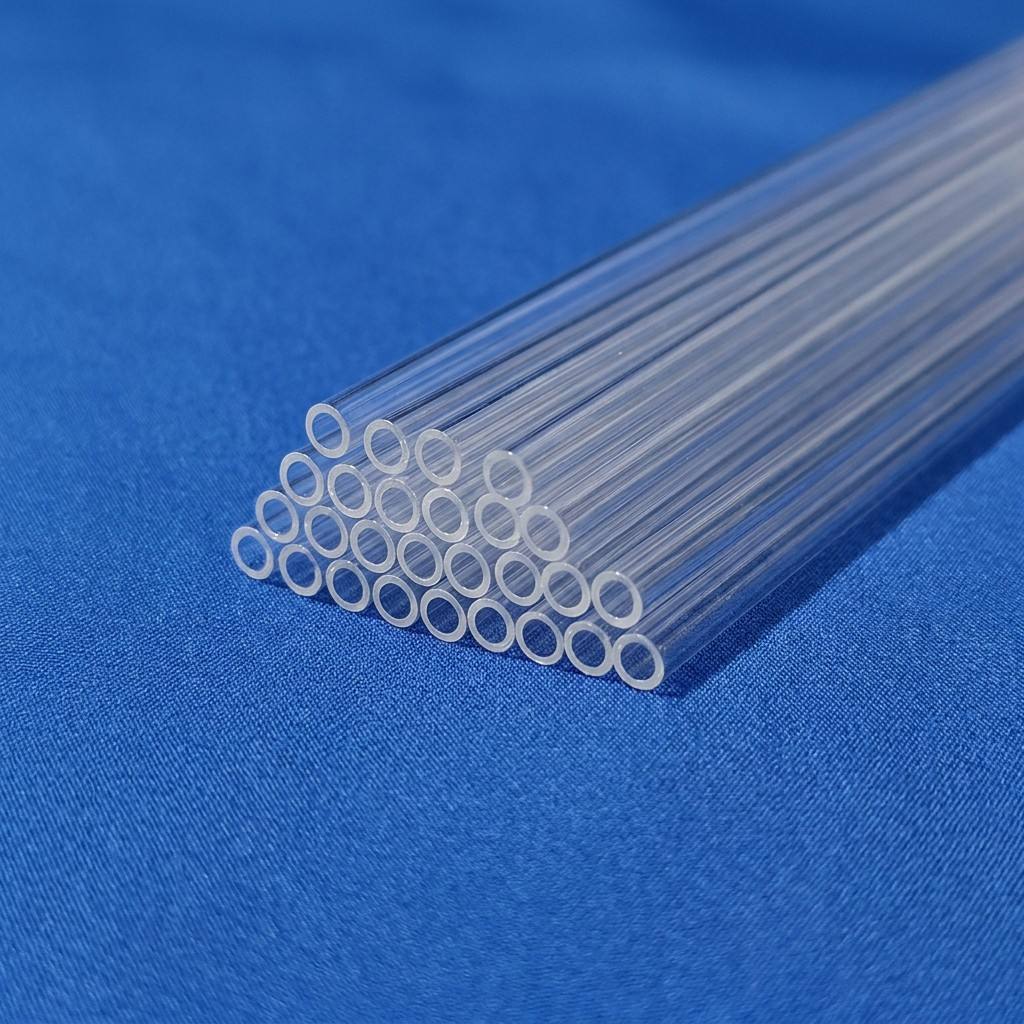
Precision quartz capillary tubing represents the pinnacle of micro-dimensional vitreous silica fabrication. In analytical chemistry, biopharmaceutical purification, microelectronics, and laser photonics, standard borosilicate or polymeric tubing fails due to thermal expansion, optical attenuation, and leaching contamination. Fused quartz capillaries, synthesized from high-purity crystalline silica or chemical vapor silicon precursors, deliver unmatched thermal resistance (softening point ≈ 1,683°C, continuous operation up to 1,100°C) combined with a virtually negligible coefficient of thermal expansion (5.5 × 10⁻⁷ /°C).
When selecting a qualified manufacturing partner in China, tier-one international procurement teams examine not only outer diameter (OD) and inner diameter (ID) specifications, but the underlying thermodynamic draw process. A stable, non-turbulent vertical drawing tower equipped with laser interferometer feedback ensures concentricity ratios exceeding 98%, zero internal striations, and an inner bore surface roughness of Ra < 0.05 μm. This internal finish is vital to prevent peak broadening in gas chromatography (GC) and turbulent micro-vortices in electrokinetic flow cells.
Deep-UV to NIR Optical Window
Standard natural fused quartz transmits flawlessly from 220 nm to 2,500 nm. For capillary electrophoresis detection cells, our synthetic fused silica option extends deep-UV transmittance down to 180 nm, eliminating spectral background distortion during high-sensitivity photometric absorbance tests.
Hydraulic Smoothness & Chemical Inertness
Except for hydrofluoric acid and concentrated phosphoric acid at elevated temperatures, fused silica capillaries resist virtually all aggressive solvents, acidic eluents, and organic phases. Smooth mirror-polished interior walls eliminate sample carryover and bio-molecular wall adhesion.
Extreme Thermal Shock Resilience
Capable of enduring immediate transitions from 1,100°C direct to ice water immersion without micro-fracturing or optical clouding. This ultra-low expansion profile ensures total volumetric stability for precision gas dosing and temperature-cycling reactors.
VEZLO Quartz: Donghai's Capital Advantage
Operating from a 50-mu (≈33,000 m²) integrated facility backed by RMB 10 million in fixed assets, VEZLO controls the entire value chain from ultra-pure quartz sand beneficiation to micron-level glass capillary drawing.
Our core R&D achievements include the 320 mm high-purity quartz tube executed under the prestigious Jiangsu Provincial Science & Technology Support Project, alongside our newly developed 520 mm large-diameter furnace components that passed national new product reviews. Every capillary tube we ship benefits from this high-caliber thermal and chemical processing infrastructure.
Contact UsRaw Material Beneficiation (≤20 ppm Impurities)
13 standardized grades of high-purity sand with conventional metal contaminants kept below 20 ppm to prevent devitrification and bubbling during drawing.
Precision Down-Draw Towers & Automated Gauging
Equipped with dual-axis laser diameter monitors running at 1000 Hz, instantly adjusting draw speed to hold tolerances tighter than ±0.002 mm.
Secondary Fabrications & Custom Geometry
Full in-house capability for laser cleaving, mechanical scoring, fire-polishing, multi-lumen bores, flared funnels, and polyimide/protective sleeve applications.
Verified Global Export Compliance
Onsite-verified operations, trade assurance integration, rapid engineering response under 2 hours, and high-impact custom crating ensuring zero-breakage delivery.
Targeted Quartz Capillary Tube Product Recommendations
Match your specific industrial application with optimal material purities, protective coatings, and dimensional tolerances.
Gas Chromatography (GC) Capillaries
Recommended Spec: ID 0.10 mm to 0.53 mm | OD 0.20 mm to 0.65 mm.
Features ultra-smooth internal walls with customized polyimide coatings capable of continuous operation at 350°C to 400°C. Delivers outstanding mechanical flexibility without brittle snap, ensuring sharp elution peaks for hydrocarbon, environmental, and forensic spectrometry.
Capillary Electrophoresis (CE) Tubes
Recommended Spec: ID 0.025 mm to 0.10 mm | Deep-UV Grade Synthetic Silica.
Engineered for minimal background auto-fluorescence. In-line detection windows are created by stripping localized polyimide coatings with precision thermal stripping, allowing direct deep-UV laser induced fluorescence (LIF) detection down to 190 nm.
Fiber Optic Ferrules & Alignment Sleeves
Recommended Spec: Circular or Rectangular Bore | OD ±0.005 mm | Concentricity ≥99%.
Used in telecommunications, DWDM components, and high-power collimators. Fused quartz matches the optical expansion characteristics of silica fiber cores, avoiding insertion losses across wide operating temperature envelopes (-40°C to +125°C).
Medical Dosing & Cytometry Flow Cells
Recommended Spec: Square or Micro-Channel Profile | Polished Optical Windows.
Square interior cross-sections eliminate the optical lensing effect inherent to cylindrical glass tubes, ensuring uniform laser illumination of laminar biological cells in hydrodynamic focusing systems and automated hematology analyzers.
Thermocouple Protection & Sensor Capillaries
Recommended Spec: Multi-Lumen (2-hole, 4-hole) | Heavy Wall | Natural Quartz.
Isolates ultra-fine noble metal thermocouple wires (Type R, S, B) in semiconductor diffusion furnaces and crystal pulling reactors. Prevents electrical shorts and atomic migration poisoning at elevated temperatures up to 1,200°C.
Laser Flow Tubes & Liquid Waveguides
Recommended Spec: Precision Bore ID 0.5 mm to 3.0 mm | Ultra-pure SiO₂.
Applied as fluid cooling channels or liquid laser gain media sheaths. Excellent UV laser solarization resistance guarantees long operational lifetimes without photolytic degradation or color center generation.
Standard Dimensional & Material Tolerance Matrix
Comprehensive baseline parameters for engineers and procurement managers drafting technical purchase briefs.
| Capillary Type | Inner Diameter (ID) Range | Outer Diameter (OD) Range | Tolerance Standard | Concentricity | Primary Coating / Finish |
|---|---|---|---|---|---|
| Microbore Chromatography | 0.005 mm – 0.050 mm | 0.100 mm – 0.360 mm | ±0.002 mm | ≥ 98% | Standard Polyimide (350°C) |
| Standard Analytical GC/CE | 0.050 mm – 0.530 mm | 0.150 mm – 0.680 mm | ±0.003 mm | ≥ 98.5% | High-Temp Polyimide (400°C) |
| Optical Fiber Alignment | 0.125 mm – 0.500 mm | 1.000 mm – 3.000 mm | ±0.002 mm | ≥ 99.0% | Bare Silica / Fire-Polished |
| Square Flow Cell Capillary | 0.100 mm – 2.000 mm | 0.300 mm – 4.000 mm | ±0.005 mm | ≥ 97.5% | Optical Flat Window 4-Sides |
| Multi-Bore / Twin Lumen | 0.200 mm – 1.500 mm (x2) | 1.200 mm – 5.000 mm | ±0.008 mm | ≥ 97.0% | Heavy Wall Bare Vitreous Silica |
| High-Purity Sensor Sheath | 0.500 mm – 3.000 mm | 1.500 mm – 8.000 mm | ±0.010 mm | ≥ 98.0% | Closed Domed / Flanged End |
Global Procurement & Technological Trends (2025–2030)
Market intelligence analysis for OEM equipment integrators navigating supply chain risk, automation, and material science shifts.
1. Near-Zero Hydroxyl (OH⁻) Absorption Trends
Next-generation NIR spectroscopic flow systems and specialized medical surgical lasers demand capillaries with hydroxyl levels below 1 ppm. While conventional fused quartz holds 10 to 30 ppm of OH, advanced vacuum desiccation and chlorine-plasma dehydration procedures are emerging as essential vendor prerequisites to eliminate absorption peaks at 1,380 nm and 2,200 nm.
2. Supply Chain Diversification Toward Integrated Hubs
Global instrumentation OEMs are consolidating vendors, shifting away from fragmented trading intermediaries toward fully integrated manufacturers located directly in raw crystal regions like Donghai. Direct access to local high-purity raw feedstock (≤20 ppm total metal limits) mitigates geopolitical supply shockwaves and dampens raw material inflation across multi-year contracts.
3. Ultra-Fast Femtosecond Laser Cleaving
Traditional diamond blade scoring causes microscopic edge chipping (>10 μm) and sub-surface fractures that propagate into structural failure under high-pressure liquid chromatography (HPLC up to 15,000 psi). The industry is aggressively standardizing on non-contact cold femtosecond laser cutting, producing perfectly perpendicular, defect-free ends with facet roughness Sa < 0.2 μm.
4. Multi-Lumen & Microfluidic Array Capillaries
The convergence of lab-on-a-chip diagnostics and point-of-care genetic analyzers has accelerated the demand for multi-lumen silica capillaries containing 7 to 19 micro-channels within a single outer diameter sheath. These structures allow simultaneous sample delivery, reagent mixing, and optical sensing in one integrated micro-platform.
5. Digitized Dimensional Traceability (QC 4.0)
Aerospace, medical, and semiconductor buyers increasingly require reel-by-reel digital metrology logs. High-volume capillary exporters must now provide continuous inline laser gauging data, demonstrating standard deviation (σ) values within 0.0008 mm throughout continuous kilometer-long production spools.
6. High-Temperature Fluoro-Polymer Coatings
While traditional polyimide serves up to 380°C, severe process monitoring requires optical transparent fluoro-polymer or aluminum-clad silica coatings capable of withstanding corrosive moisture, aggressive chemical vapors, and temperatures exceeding 450°C without shedding particulates.
Quartz Capillary Procurement FAQ
Detailed engineering and commercial answers to frequent questions raised by procurement directors and lead design engineers.
Through our specialized vertical drawing towers with automated micro-feed control, we produce precision fused silica capillaries with an inner diameter down to 0.005 mm (5 μm) with a tolerance of ±0.0015 mm. Outer diameters for these ultra-fine micro-capillaries are typically engineered between 0.100 mm and 0.360 mm to retain operational flexural elasticity.
Natural fused quartz is synthesized from high-purity natural quartz sand (Donghai deposits, SiO₂ ≥ 99.99%, metallic impurities ≤ 20 ppm). It is the most economical choice, delivering outstanding thermal endurance up to 1,100°C, superior mechanical stiffness, and broad transmission from 220 nm to 2,500 nm. Synthetic fused silica is created through the vapor oxidation of silicon tetrachloride (SiCl₄). It contains virtually undetectable metallic impurities (< 0.1 ppm), eliminates bubble inclusions completely, and offers deep-UV transmission down to 180 nm, making it the non-negotiable benchmark for UV-LIF detection and high-energy excimer laser applications.
Pristine drawn fused silica has enormous tensile strength (> 100 kpsi), but its surface is highly sensitive to environmental moisture and micro-abrasions, which can trigger catastrophic brittle shattering. A thin (12 to 24 μm) outer layer of high-temperature polyimide shields the glass surface, maintaining bend flexibility down to bend radii of a few centimeters. For optical detection windows in chromatography or capillary electrophoresis, the polyimide can be cleanly removed locally via specialized thermal desorbers, hot sulfuric acid dipping, or automated excimer laser ablation without compromising underlying wall integrity.
Standard shipments include an exhaustive Material Quality Certificate (CoQ), Spectrochemical ICP-MS Purity Reports (tracking Fe, Al, Ti, Ca, Mg, Na, K concentrations), Laser Metrology Inspection Sheets (ID, OD, Ovality, and Wall Concentricity), and surface finish certification. Custom hydrostatic pressure testing logs (up to 10,000+ psi burst test samples) are available upon project specification.
We mitigate all transit risks using multi-tier protective packaging. Short, rigid capillaries are packed in anti-static, shock-absorbing cleanroom plastic tubes suspended in custom-molded high-density EVA foam. Long, flexible capillary columns (10 m to 100 m continuous lengths) are wound on precision-tensioned plastic reels, hermetically vacuum-sealed in moisture-barrier foil bags, and housed inside reinforced, drop-tested export cartons or fumigation-free plywood shipping cases.
Our dedicated international technical sales team responds to RFQs with preliminary engineering assessments within 2 hours. For standard capillary dimensions held in raw stock, prototype samples ship within 3 to 5 business days. Custom dimensional draws, specialized multi-lumen profiles, or complex CNC-machined/flanged end terminations typically require 10 to 15 business days for precision tooling, draw stabilization, and metrology sign-off.
Accelerate Your Engineering Project With Precision Quartz Capillaries
Direct communication with experienced quartz glass blowing technicians and draw engineers. Submit your dimensional drawings, target bore tolerances, and operating environment requirements for rapid DFM analysis and competitive factory-direct pricing.
Contact Us