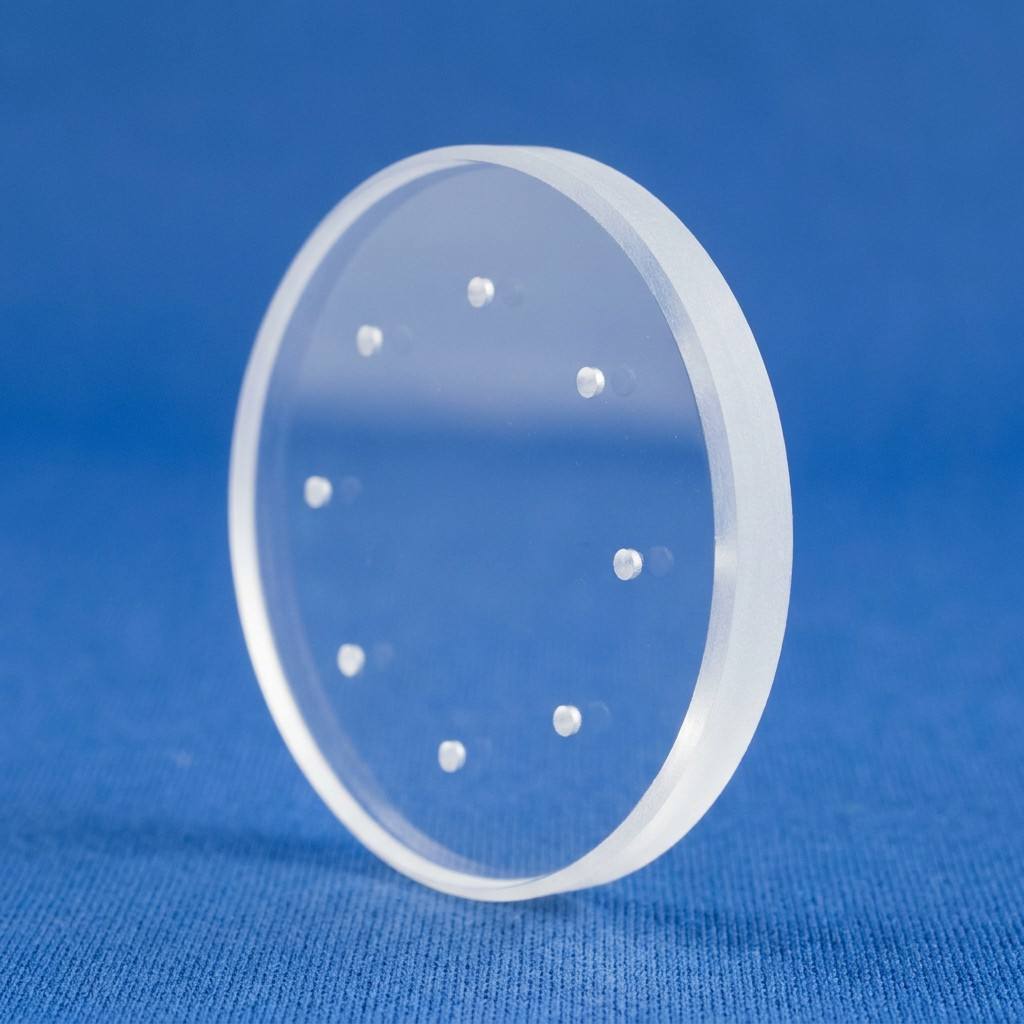
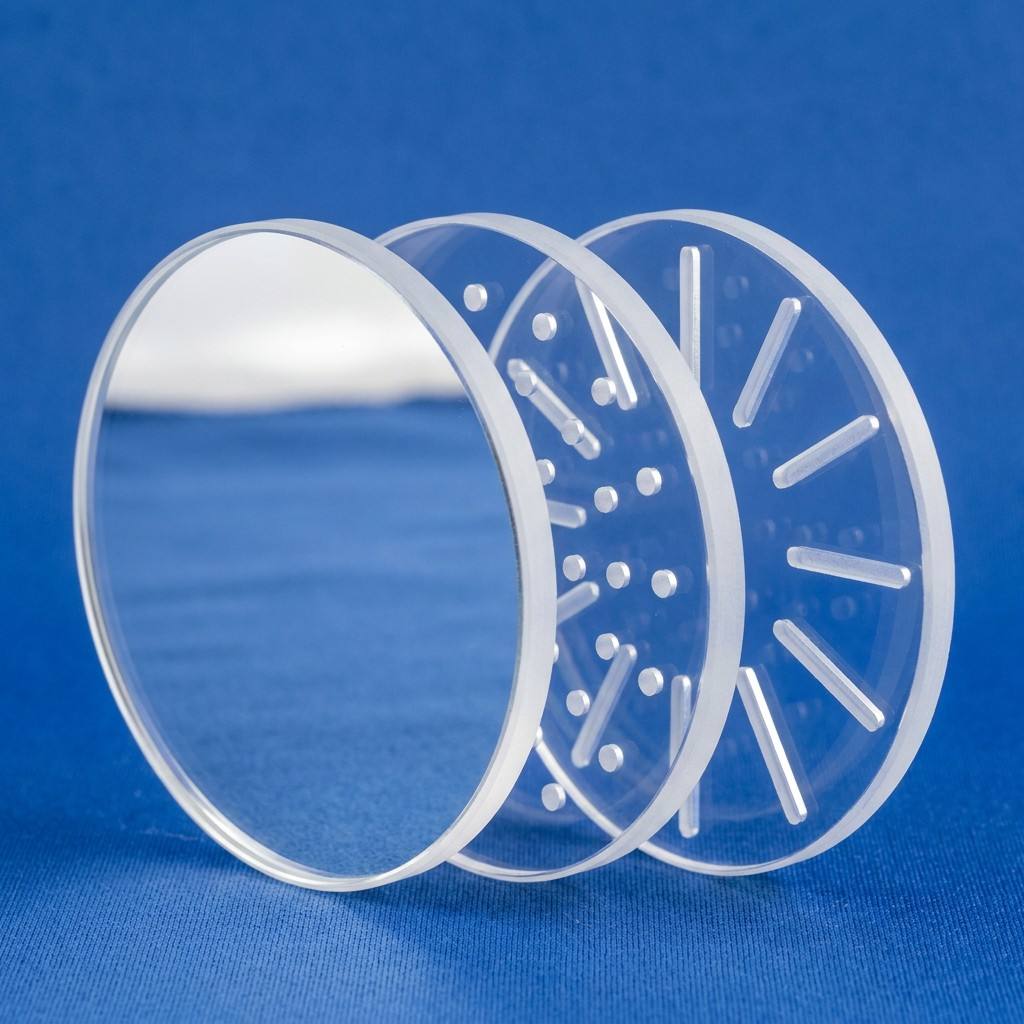
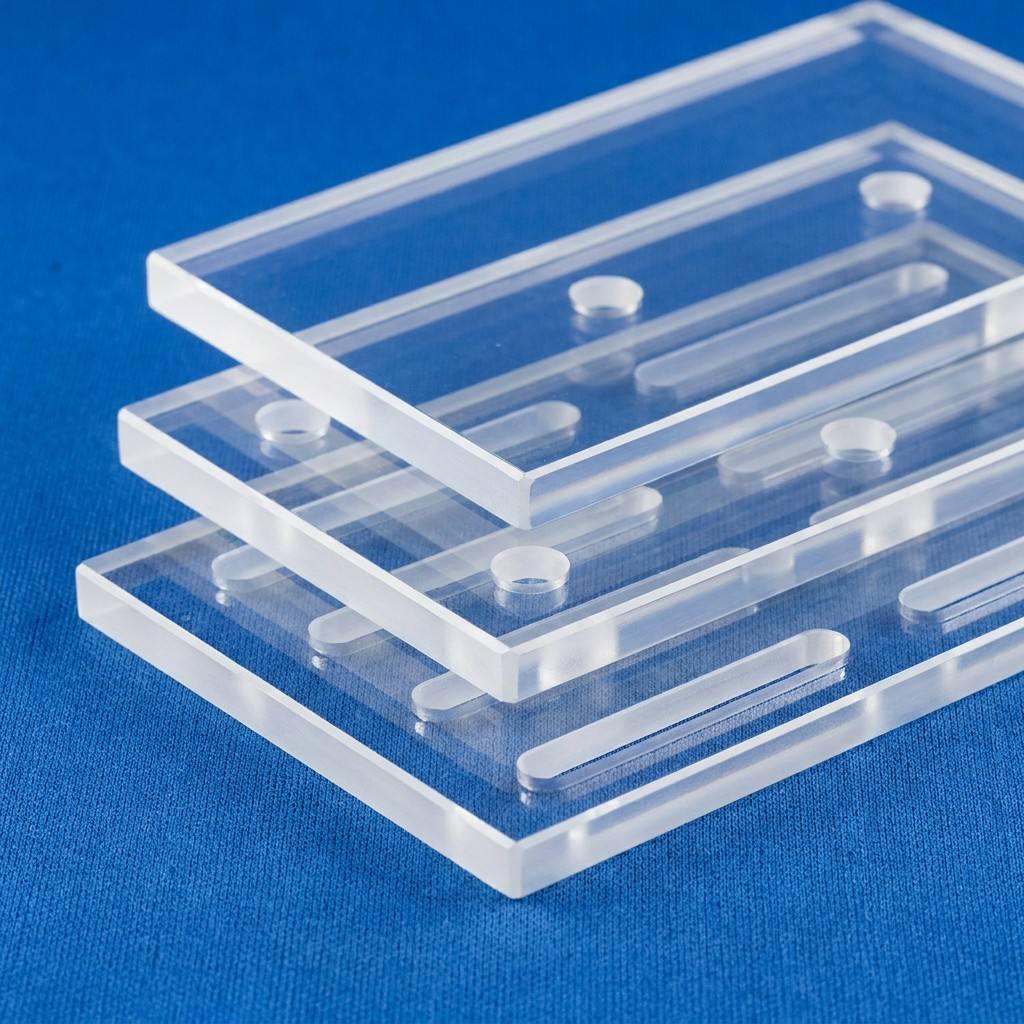
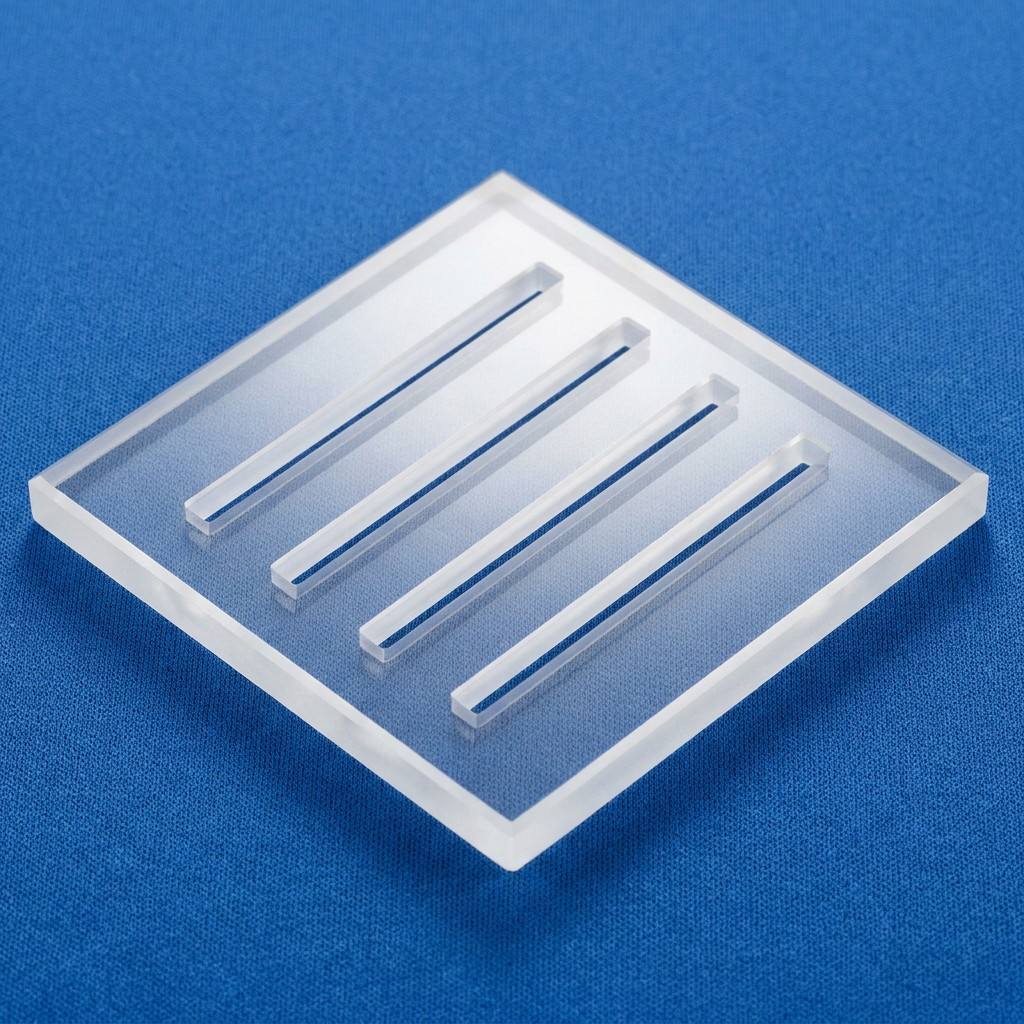
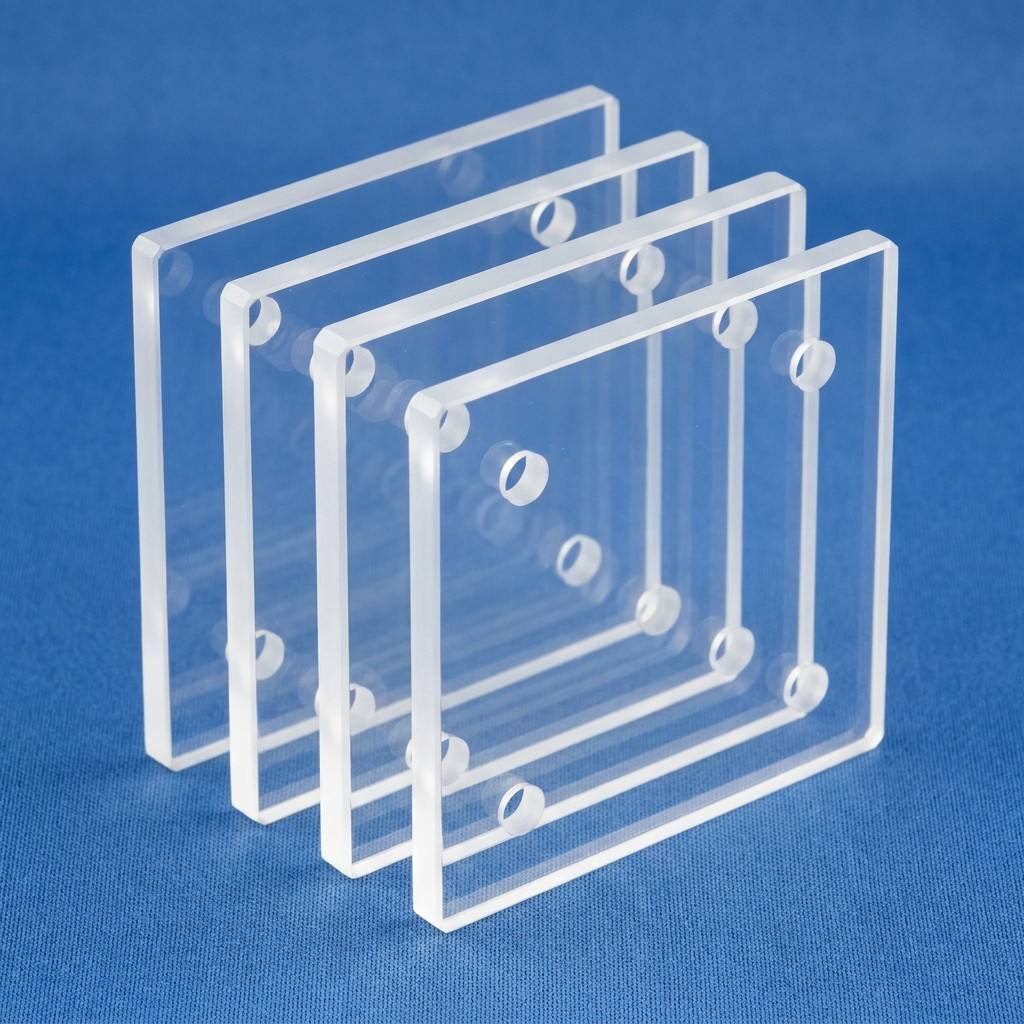
Precision ground bevel edges engineered to eliminate micro-cracking and chip defects under high thermal cycling environments in semiconductor diffusion chambers.
Synthetic fused silica substrate engineered for DUV laser processing, high damage threshold optics, and optical shield barriers in precision photolithography.
Technical White Paper: The Role of Ultra-Pure Quartz in Semiconductor Diffusion
In modern sub-micron semiconductor fabrication and photovoltaic cell manufacturing (TOPCon, Heterojunction), the quartz diffusion tube operates under severe thermomechanical stress and extreme chemical exposure. During high-temperature oxidation, drive-in diffusion, and low-pressure chemical vapor deposition (LPCVD), quartz process tubes must sustain sustained temperatures between 1050°C and 1250°C while maintaining structural concentricity, dimensional stability, and zero volatile outgassing. The purity of the quartz envelope is paramount: alkali metal elements (such as Na, K, and Li) exhibit extremely rapid diffusion coefficients through silicon dioxide lattices at thermal process thresholds. If present in quantities greater than sub-part-per-million levels, these mobile ions migrate directly into the bare silicon wafers, forming localized lattice defects, shifting MOS threshold voltages, and drastically suppressing minority carrier lifetimes.
As an authoritative OEM manufacturer based in Donghai County—China's natural quartz capital—our process utilizes ultra-pure natural quartz raw sands (SiO2 ≥ 99.995%) refined through multi-stage beneficiation, acid washing, and magnetic induction separation. This process restricts total conventional metal impurities to ≤20 ppm, with heavy metals like Fe, Cu, Ni, and Cr individually constrained below 0.1 ppm. The structural integrity of each quartz diffusion tube is governed by its hydroxyl radical ([OH−]) level. Controlling [OH−] content below 20 ppm dramatically elevates the glass viscosity, shifting the annealing point upward to 1215°C and softening point to approximately 1683°C. This critical material boundary provides exceptional resistance against high-temperature dimensional distortion, sag, and early devitrification (transformation from amorphous vitreous quartz into crystalline β-cristobalite).
Physical / Thermal Parameter
Standard Clear Fused Quartz
Semiconductor-Grade Fused Silica
Procurement Significance & Tolerance Limit
Purity (SiO2 Purity wt%)
≥ 99.99%
≥ 99.998% to 99.999%
Prevents trace heavy metal vapor cross-contamination in batch wafers
Thermal Expansion (0–1000°C)
5.5 × 10⁻⁷ / °C
5.2 × 10⁻⁷ / °C
Enables rapid thermal ramp rates (>15°C/min) with zero thermal shock fracture
Softening Point (Log η = 7.6)
1,683 °C
1,710 °C
Determines maximum thermal headroom during high-temp drive-in steps
Annealing Point (Log η = 13.0)
1,215 °C
1,230 °C
Defines internal stress relaxation boundary after flame welding flanges
Continuous Service Temperature
1,100 °C
1,150 °C – 1,200 °C
Baseline rating for longevity in continuous 24/7 horizontal/vertical furnaces
Hydroxyl Group Content ([OH−])
≤ 30 ppm (Flame/Electric)
≤ 5–10 ppm (Dry Melt)
Directly governs high-temperature sagging resistance and devitrification rates
Dimensional Ovality / Run-out
≤ 1.5% of Outer Diameter
≤ 0.5% (Max 0.8 mm)
Guarantees airtight seal with stainless steel water-cooled furnace door collars
In addition to furnace core tubes, thermal process assemblies require matching high-precision auxiliary quartzware: multi-slot wafer boats, gas distribution injectors, thermal baffles, thermocouple protective sheaths, and exhaust scavenger flanges. These complex structures undergo advanced thermal annealing following hydrogen-oxygen flame torch fusion to completely neutralize latent internal stress fields. This prevents catastrophic spontaneous glass fracture caused by localized photoelastic birefringent gradients during subsequent rapid heat-cool thermal cycles.
Market Intelligence & Sourcing Outlook
Future Procurement Trends for OEM Quartz Diffusion Tubes
Strategic supply chain indicators and technical evolutions shaping worldwide semiconductor and solar wafer manufacturing procurement strategies through 2026–2030.
Expansion to Large-Diameter Vertical Tubes (300mm & 520mm)
Legacy 150mm and 200mm horizontal furnace architectures are rapidly shifting toward automated vertical furnace systems handling 300mm (12-inch) wafers. Procurement demand has permanently gravitated toward massive monolithic quartz tubes with outer diameters exceeding 320 mm to 520 mm. Sourcing managers now prioritize factories capable of drawing continuous heavy-wall tubes up to 520 mm while holding total longitudinal wall thickness variation within ±0.2 mm.
Class 100 Cleanroom Packaging & Surface Functionalization
Global buyers increasingly mandate pristine, ready-to-install (RTI) quartzware. Modern procurement requirements specify ultra-high-purity final etching in class 100/ISO 5 cleanroom facilities, followed by multi-stage ultra-pure water (UPW, 18.2 MΩ·cm) ultrasonic megasonic rinsing and nitrogen blow-drying. The tube must arrive hermetically encased in double-layer vacuum anti-static bagging, eliminating secondary customer cleanroom decontamination procedures.
Supply Security via Geographically Integrated Clusters
With geopolitical disruption impacting global rare-earth and quartz supply continuity, enterprise procurement directors are consolidating vendor portfolios around vertically integrated manufacturers located directly in industrial mineral hubs like Donghai, China. Securing raw sand refining, continuous tube drawing, hot flame working, and CNC cold milling under a single vendor umbrella mitigates raw material price volatility and cuts lead times by over 40%.
Next-Gen Fabrication R&D
Technological Innovations in High-Performance Quartz Glass
Engineering advancements solving thermal sagging, devitrification kinetics, and chemical plasma erosion in next-generation thermal nodes.
Electric Vacuum Fusion with Synthetic Doping
Traditional oxy-hydrogen gas flame fusion naturally introduces high hydroxyl ion concentrations ([OH−] > 150 ppm) into the glass network, substantially weakening Si-O-Si bridging bonds. Next-generation electric vacuum melting technology operates under inert atmospheres, successfully lowering [OH−] levels down to below 5 ppm. The resulting tubes demonstrate a 50°C higher softening boundary, allowing furnaces to operate continuously at 1250°C without creep or sagging.
Anti-Devitrification Nanostructured Coatings
During prolonged high-temperature thermal cycling, particulate and atmospheric alkaline surface contamination acts as heterogeneous nucleation centers, converting amorphous quartz into β-cristobalite. Upon cooling below 270°C, cristobalite undergoes a rapid 5% volume contraction from β to α phase, resulting in catastrophic spalling. R&D efforts now apply proprietary aluminum-silicon nanocoatings that suppress surface crystallite nucleating kinetics, extending tube operating life by up to 2.5×.
Sub-Micron Laser Ultrasonic CNC Trepanning
Complex quartz diffusion assemblies require intricate side-welded gas injectors, optical pyrometer ports, and vacuum ball joints. Traditional flame-piercing introduced significant micro-stresses and wall-thinning distortions around penetration perimeters. Modern automated 5-axis ultrasonic CNC milling paired with picosecond laser cutting allows micro-machining of ports with edge chipping controlled within ≤10 μm, enabling precise stress-free flame joining.
Enterprise Excellence: Grounded in China's Quartz Capital
VEZLO Quartz Products Co., Ltd. operates an advanced 50-mu (≈33,000 m²) integrated manufacturing base in Donghai County, Jiangsu Province—the epicenter of natural quartz refinement in China. Powered by over RMB 10 million in fixed assets, we manage every phase of the quartz transformation journey: from raw quartz sand beneficiation to automatic high-temperature tube drawing, cold CNC precision polishing, and cleanroom vacuum packaging.
Our commitment to semiconductor excellence is demonstrated through our direct execution of the Jiangsu Provincial Science & Technology Support (Industrial) Project, focusing on 320 mm ultra-pure quartz furnace tubes. Furthermore, our proprietary 520 mm large-diameter high-purity quartz tube has passed preliminary national new product reviews. By channeling over RMB 5 million into research and development annually, we provide global Tier-1 equipment makers with consistent quality, traceable metallurgy, and responsive engineering support.
33,000 m²
Production Campus
¥10M+
Fixed Asset Capital
13 Grades
High-Purity Quartz Sand
Provincial & National R&D Recognition
Our 320 mm high-purity IC furnace tube project and 520 mm large-diameter tubes represent top-tier domestic breakthroughs in thermal process quartz glass manufacturing.
Onsite Verified & Trade Assurance Supported
Independently verified physical premises and transaction integrity, backed by global export safety crates lined with anti-shock pearl foam and moisture barriers.
Rapid Engineering Turnaround (≤ 2 Hours)
Direct dialogue with dedicated glass-blowing masters and optical engineers. We review customer STEP/DWG drawings, provide thermal calculations, and return DFM feasibility reports within two hours.
Crucial technical answers addressing dimensions, purity validation, chemical etching, thermal maintenance, and OEM drawing requirements.
What outer diameter (OD) and wall thickness ranges can VEZLO produce for diffusion tubes?
We draw standard transparent fused quartz tubes continuously across an outer diameter range of 2 mm up to 500 mm. For cutting-edge vertical semiconductor diffusion, LPCVD, and oxidation furnace equipment, we produce large-diameter tubes up to 520 mm with custom wall thicknesses ranging from 4.0 mm to 12.0 mm, maintaining strict wall uniformity (±0.15 mm) and length allowances up to 3500 mm.
How do you verify metallic purity and trace alkali contamination?
Every production batch undergoes strict Inductively Coupled Plasma Mass Spectrometry (ICP-MS) and optical emission spectrometry testing. Total metallic elements (including Fe, Al, Ca, Mg, Ti, Cu, Ni, and Cr) are guaranteed ≤20 ppm, while mobile alkali ions (Na, K, Li)—the most hazardous contaminants in MOS architectures—are kept below 0.5 ppm. Comprehensive material test certificates (MTC) accompany each export delivery.
What is the standard procedure for pre-installation cleaning and HF etching?
Before loading into thermal diffusion furnaces, tubes should undergo chemical immersion in a 5%–10% high-purity Hydrofluoric Acid (HF) bath for 10 to 15 minutes to strip native surface micro-cracks and environmental particulate matter. Never exceed 15 minutes, as over-etching exposes internal microscopic gas bubbles. Immediately rinse with cascading 18.2 MΩ·cm DI water until resistivity stabilizes, followed by high-purity filtered nitrogen blow-dry in an ISO Class 5 hood.
How do you prevent high-temperature sagging and ovalization in horizontal tubes?
Horizontal furnace tubes suffer sagging due to gravitational creep at temperatures exceeding 1150°C. We counteract this through two methods: first, synthesizing the tube using low-OH [OH− ≤ 10 ppm] raw material, boosting high-temperature viscosity by nearly an order of magnitude; second, engineering wall thickness profiles specifically tailored to support self-weight across unsupported furnace spans.
Can VEZLO customize custom end-closures, flanged joints, and multi-port branches?
Yes. We specialize in bespoke OEM/ODM hot fabrication and cold machining. Our master glassblowers fabricate custom ball joints, O-ring grooved flanges, flared bells, flat or domed sealed ends, gas injection sub-manifolds, and quartz-to-metal transition interfaces directly tailored to customer engineering drawings.
What packing methods ensure zero breakage during international sea and air freight?
Fragile quartz tubes are wrapped in anti-static, dust-free polyethylene film, encased inside custom shock-absorbing high-density closed-cell EPE pearl foam collars, and suspended inside rigid internal multi-wall cartons. This assembly is then secured inside heavy-duty, fumigation-free solid plywood crates fitted with multi-directional shock indicator sensors and tilt monitors for secure transit.
Accelerate Your Thermal Furnace Sourcing Today
Submit your technical drawings (CAD / DWG / PDF), operating parameters, and annual volume requirements. Our factory engineering specialists will verify technical feasibility, optimize wall tolerances, and provide an official quotation within 2 hours.