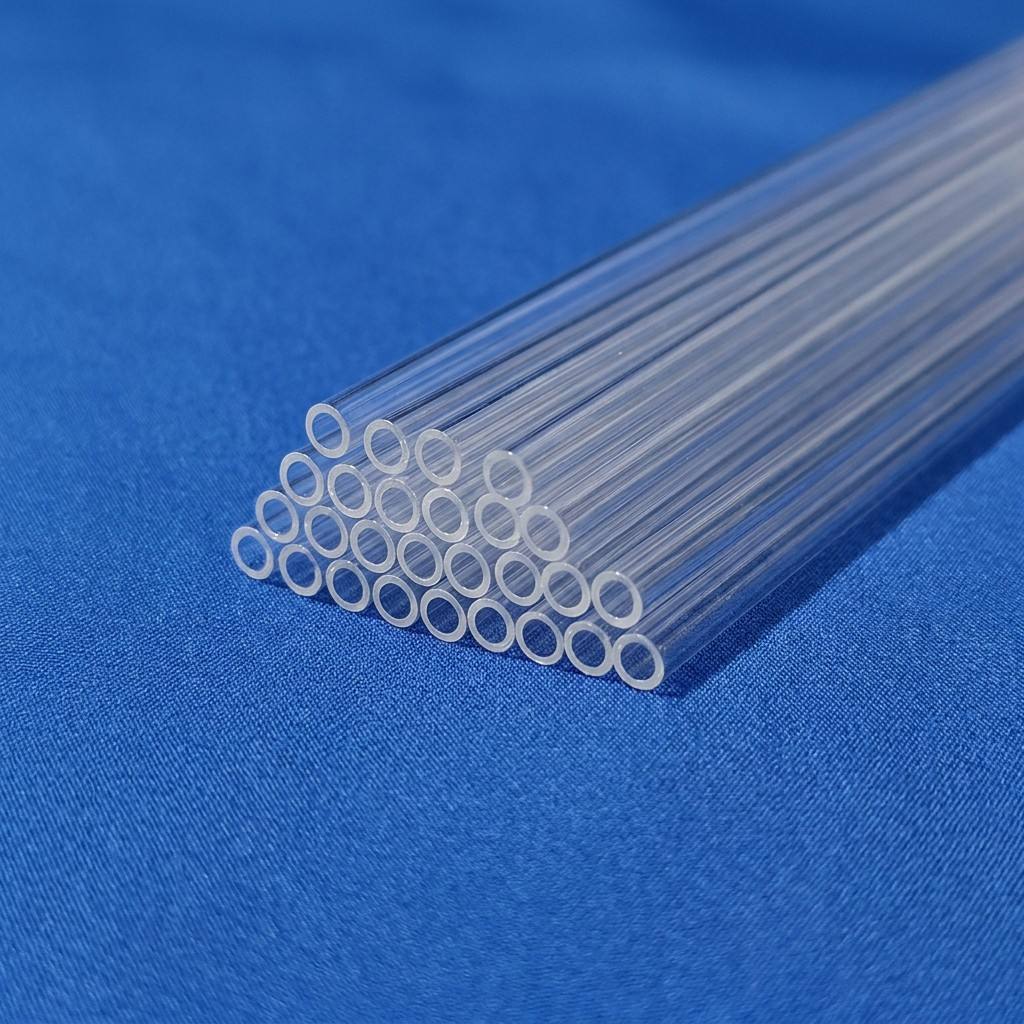
Clear Fused Silica Quartz Glass Tube Blank
Raw stock transparent pipe blank for glassblowing workshops, hot bending, thermal furnace sleeves, and industrial diffusion liners.
Manufactured from ultra-pure natural crystal sands and synthetic silica precursors (≤20 ppm total metallic impurities). Available in custom thicknesses (0.3 mm to 50 mm), bespoke geometries, optical ground-and-polished finishes (Ra < 0.5 nm), and tight parallel tolerances.
Raw stock transparent pipe blank for glassblowing workshops, hot bending, thermal furnace sleeves, and industrial diffusion liners.

Double-side clear-polished optical fused silica substrates designed for microfabrication, CMP wafer polishing carriers, and lithography.

Custom thermal-shock resistant fused silica substrate plate exhibiting extreme electrical resistivity and minimal trace metal content (≤15 ppm).

High-pressure and ultra-high vacuum (UHV) viewport flanges with high broadband transmission across deep ultraviolet to near infrared spectra.
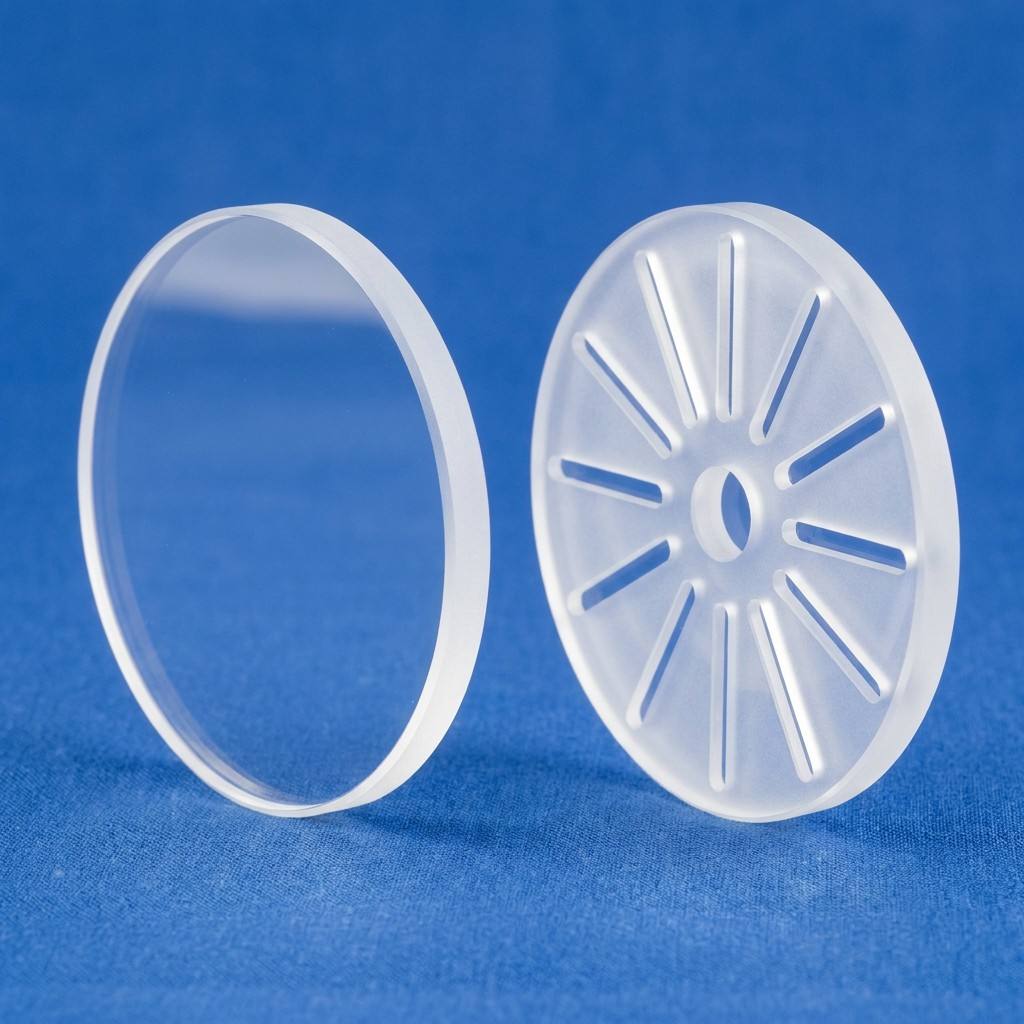
Precision-lapped ultra-thin fused silica sheets down to 0.2mm/0.3mm with surface roughness Ra ≤ 0.5nm for biochips, MEMS, and laser coverslips.
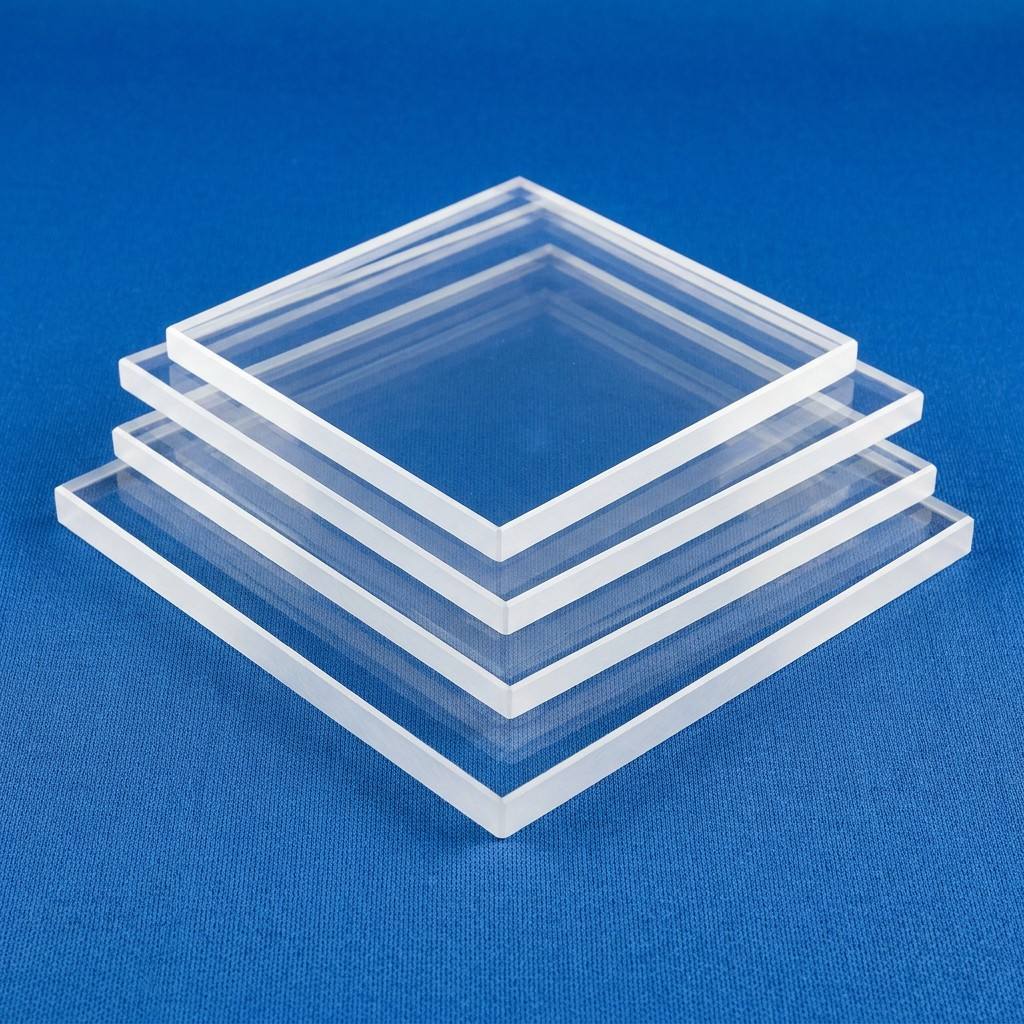
Ultrasonic-core drilled and chamfered fused silica disc plate tailored for optical encoders, heating lamp bases, and vacuum gas delivery ports.
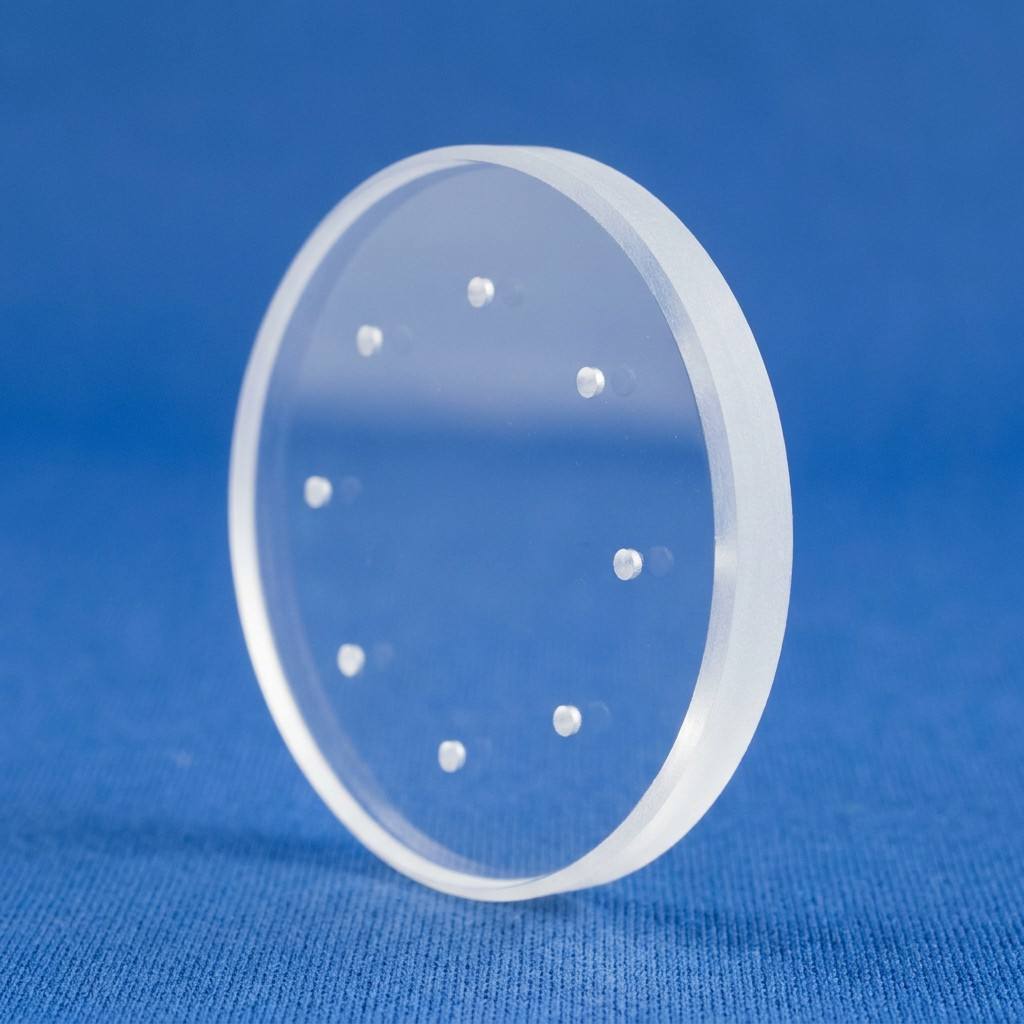
5-axis CNC profiled quartz sheets with intricate step slots, counterbores, beveled edge arrays, and fire-polished edges for plasma etch chambers.

Circular fused quartz discs and sight glasses cut to custom diameter (Ø10 mm to 600 mm) with beveling, optical anti-reflective coating, and laser etching.
Quartz glass sheets—often referred to interchangeably in industrial engineering contexts as fused quartz plates, fused silica substrates, or vitreous silica windows—constitute a mission-critical class of dielectric and optical materials. Fabricated by converting high-purity crystalline silicon dioxide (SiO&sub2;) through electrical vacuum fusion, oxy-hydrogen flame fusion, or chemical vapor synthesis into an amorphous cross-linked silicon-oxygen tetrahedron network, these sheets possess a virtually unmatched combination of extreme thermal shock resistance, wide spectral optical transmission spanning from 190 nm (Deep UV) to 3,500 nm (Near Infrared), exceptionally high electrical breakdown strength, and near-absolute chemical inertness.
As semiconductor wafer fabrication migrates below 3 nm sub-nodes, high-density packaging architectures (2.5D/3D chiplets) accelerate, and high-fluence laser processing tools expand into industrial gigafactories, procurement engineers face stringent specifications regarding bubbled inclusions, metallic contamination, optical wave-front distortion, and micro-roughness. At VEZLO Quartz Products Co., Ltd., based in Donghai County—recognized globally as "China's Quartz Center"—we manage a vertically integrated manufacturing ecosystem covering raw high-purity quartz (HPQ) refining, ingot fusion, precision wire-saw slicing, double-sided optical lapping, CNC ultrasonic profile machining, and cleanroom vacuum annealing.
| Physical / Dielectric Property | Fused Quartz Sheet (JGS2/3) | Synthetic Fused Silica (JGS1) |
|---|---|---|
| SiO&sub2; Chemical Purity | ≥ 99.99% (≤20 ppm metals) | ≥ 99.9999% (≤0.5 ppm metals) |
| Density at 20°C | 2.20 g/cm³ | 2.201 g/cm³ |
| Thermal Expansion Coeff. (0–300°C) | 5.5 × 10⁻⁷ /°C | 5.2 × 10⁻⁷ /°C |
| Max Continuous Service Temperature | 1,100 °C | 1,150 °C |
| Short-Term Peak Softening Point | 1,683 °C | 1,730 °C |
| Dielectric Constant (ε) at 1 MHz | 3.75 | 3.80 |
| Dielectric Loss Factor (tan δ) at 1 MHz | < 1.0 × 10⁻⁴ | < 4.0 × 10⁻⁵ |
| Transmittance Window Range | 260 nm – 2,500 nm | 185 nm – 2,100 nm (DUV Grade) |
| Surface Roughness Capability (Ra) | ≤ 0.8 nm | ≤ 0.3 nm (Super-Polished) |
Avoid procurement delays and costly machining scrap by detailing the following six critical criteria when issuing RFQs for custom quartz plates:
How front-end semiconductor fabrication, advanced packaging, optical clean energy, and quantum sensing are transforming global fused silica supply chain strategies.
Advanced semiconductor nodes demand synthetic fused silica sheets with near-zero thermal expansion variation (< 5 ppb/K), virtually zero striae, and sub-surface damage-free polishing to eliminate phase errors under high-power EUV and high-NA immersion DUV lithography systems.
Packaging foundries are migrating from standard borosilicate to precision ultra-thin fused quartz glass sheets (0.2 mm – 0.5 mm). Quartz exhibits superior dimensional stability at temperatures exceeding 450°C, offering coefficient of thermal expansion (CTE) matching to silicon during Temporary Wafer Bonding (TWB) and debonding processes.
Solar cell manufacturing lines are scaling up furnace sizes for n-type TOPCon and perovskite-silicon tandem cells. Procuring oversized quartz windows, diffusion furnace shelves, and paddle plates capable of withstanding corrosive POCl&sub3; and BBr&sub3; atmospheres has become a critical supply-chain hedging strategy.
Global original equipment manufacturers (OEMs) are seeking qualified secondary sources outside single-source monopolies. Having certified access to the high-purity natural silica sand basin in Donghai allows VEZLO Quartz to guarantee material provenance, chemical purity traceability, and lead-time stability.
In high-density plasma (ICP/CCP) etch tools utilizing fluorine and chlorine chemistries, quartz sheets act as chamber liners and dielectric windows. Trends point toward flame-annealed quartz sheets with optimized crystalline boundary conditions to reduce micro-arcing and particle flaking.
Biomedical flow cytometry and DNA sequencing instruments require high optical transmission down to 260 nm coupled with near-zero background autofluorescence. CNC-machined and laser-ablated quartz microfluidic plates provide chemical inertness across the entire pH spectrum (except HF).
Pioneering fabrication paradigms enabling sub-nanometer surface planarization, complex monolithic geometries, and low-loss dielectric performance.
Conventional diamond grinding of brittle vitreous quartz frequently introduces subsurface micro-fissures and edge chip-outs. VEZLO integrates 20–40 kHz ultrasonic-assisted milling heads, drastically reducing cutting forces by 40–60% and enabling intricate internal cutouts, wafer handling steps, and micro-grooves with tolerances within ±0.01 mm.
Deterministic polishing employing magnetorheological finishing fluids and pitch-polishing eliminates subsurface damage (SSD). This achieves atomic-level flatness (λ/20) and surface micro-roughness below 3 Angstroms (Ra < 0.3 nm), critical for high-damage-threshold laser optics and laser gyroscopes.
Through computerized multi-stage electric vacuum annealing furnaces, quartz plates are heated through their annealing point (~1,215°C) with slow, programmed ramp-downs. This relieves internal frozen-in mechanical stresses, lowering optical birefringence below 5 nm/cm for high-precision polarization optics.
Ensuring zero critical failures in ultra-clean, high-temperature, and vacuum operational environments.
Every quartz sheet undergoes cross-polarized laser scattering metrology to scan for internal gaseous bubbles, micro-inclusions, and elongated airlines. VEZLO classifies products strictly per ISO 10110-3, ensuring zero bubbles > 0.1 mm in active optical zones.
Transmission profiles are verified across the entire spectrum (190 nm to 3,200 nm). We ensure consistent transmittance (> 90% at 254 nm germicidal bands for JGS2, and > 92% at 193 nm for JGS1 DUV grades) with certified spectrophotometer test curves included in every batch.
Zygo phase-shifting laser interferometers verify transmitted wavefront distortion, peak-to-valley (P-V) flatness, and total thickness variation across sheets up to 600 mm diameter, guaranteeing seamless hermetic sealing in high-vacuum chamber viewports.
Operating from a 50-mu (≈33,000 m²) modern production base in Donghai County—the epicenter of China's quartz crystal resources—VEZLO Quartz Products Co., Ltd. combines raw material refining, electric and gas fusion, precision CNC cold machining, and strict cleanroom metrology.
Direct access to Donghai high-purity silica sand reserves with automated magnetic separation, acid washing, and thermal cracking (≤20 ppm total metallic impurities).
Developers of the 320 mm high-purity quartz tube for Jiangsu Science & Technology Support Project, and the 520 mm semiconductor diffusion furnace tube reviewed for national new products.
Experienced bilingual CAD/DFM engineering team providing comprehensive technical quotation reviews and feasibility reports within an average of ≤2 hours.
Over 50% repeat order rate backed by multi-layer anti-shock pearl foam packaging, vacuum sealing, and export-compliant fumigation-free wooden crates for global sea, air, and courier transport.
Clear, engineering-backed answers addressing the most common questions regarding fused quartz and synthetic fused silica procurement.