High-Purity Quartz Vessels & Optical Components
Direct from our 33,000 m² primary production center in Donghai, certified for thermal shock resistance up to 1100°C and chemical inertness under acidic digestion protocols.


Pure SiO₂ Content Guarantee
Continuous Service Temperature
Trace Metallic Impurities
Rapid Engineering Response
Technical Whitepaper: Why Szeged's Research & Industrial Ecosystem Demands Fused Quartz Flasks
The city of Szeged, situated along the Tisza River in Southern Hungary, has undergone a fundamental transformation into one of Central Europe's most critical photonics, biotechnology, and academic research bastions. Anchored by the ELI-ALPS (Extreme Light Infrastructure Attosecond Light Pulse Source) facility and the multi-disciplinary laboratories of the University of Szeged (Szegedi Tudományegyetem - SZTE), the regional demand for high-performance laboratory glass has outgrown traditional borosilicate (Borosilicate 3.3) limits.
Standard laboratory glassware experiences rapid softening at temperatures approaching 520°C and exhibits pronounced ultraviolet cutoff below 310 nm. In contrast, fused quartz flasks (amorphous silicon dioxide, SiO₂) manufactured by VEZLO provide an indispensable operational envelope: continuous service thresholds reaching 1,100°C, short-term thermal excursions up to 1,300°C, an ultra-low thermal expansion coefficient of 5.5 × 10⁻⁷ /°C, and unyielding transparency in deep-ultraviolet wavelengths spanning down to 185 nm.
As an international manufacturing leader based in Donghai County—China's recognized quartz capital—VEZLO Quartz Products Co., Ltd. bridges the procurement gap for Szeged's research teams, technical institutes, and manufacturing facilities. We deliver high-purity flat-bottom, round-bottom, Erlenmeyer, Kjeldahl, and multi-neck Schlenk reaction quartz flasks custom-welded to international standard taper ground joints (such as NS 14/23, 24/29, and 29/32), ensuring zero leakage under ultra-high vacuum or hyperthermal conditions.
Material Performance Matrix: Fused Quartz vs. Borosilicate 3.3 in Advanced Chemical Synthesis
Procurement teams in Szeged frequently evaluate the balance between unit cost and physical viability. The data below outlines why critical high-energy, cleanroom, and corrosive synthesis applications necessitate fused quartz over conventional labware:
| Physical / Chemical Property | VEZLO Fused Quartz Flask | Standard Borosilicate 3.3 | Engineering Impact for Szeged Laboratories |
|---|---|---|---|
| SiO₂ Purity Grade | ≥ 99.99% (≤20 ppm total metals) | ≈ 81% (B₂O₃ ~13%, Na₂O/K₂O ~4%) | Prevents metal ion migration during high-purity API drug synthesis and trace-metal digestions. |
| Maximum Working Temperature | 1,100°C (Continuous) / 1,300°C (Short) | 450°C (Continuous) / 500°C (Short) | Enables direct open-flame heating, dry mineral calcination, and ultra-high temp boiling reactions. |
| Thermal Expansion (0–300°C) | 5.5 × 10⁻⁷ /°C | 33 × 10⁻⁷ /°C | Zero fracture risk when plunging red-hot 1,000°C flasks into ice water; Borosilicate shatters under equivalent gradient. |
| UV Transmission Range | 185 nm – 2,500 nm (Optical Grade) | 310 nm – 2,200 nm (UV Cutoff at 300 nm) | Crucial for ELI-ALPS laser photolysis, photochemical curing, and UV radical activation synthesis. |
| Acid Resistance (except HF/H₃PO₄) | Class 1 (Virtually Insoluble) | Class 1 (Slight surface etching over time) | Zero leaching of boron or alkali elements into analytical media during boiling aqua regia reflux. |
| Dielectric Loss (tan δ @ 1 MHz) | < 0.0001 | ≈ 0.0037 | Superior microwave transparency for microwave-assisted organic synthesis reactors. |
Localized Application Scenarios in Szeged
Precision-matched glassware engineered specifically for the research corridors, industrial parks, and environmental facilities operating in Csongrád-Csanád County.
1. Attosecond Laser & Photochemistry (ELI-ALPS)
The ELI-ALPS facility in Szeged conducts cutting-edge research in ultrafast laser physics, high-order harmonic generation, and laser-driven photochemistry. Our synthetic and UV-grade fused quartz flasks and reaction cells serve as direct interaction chambers:
- Extreme transparency down to 185 nm allows high-power UV and vacuum-UV beamlines to pass through without optical distortion.
- Resistant to intense laser fluence and beam-induced solarization, preventing vessel discoloration.
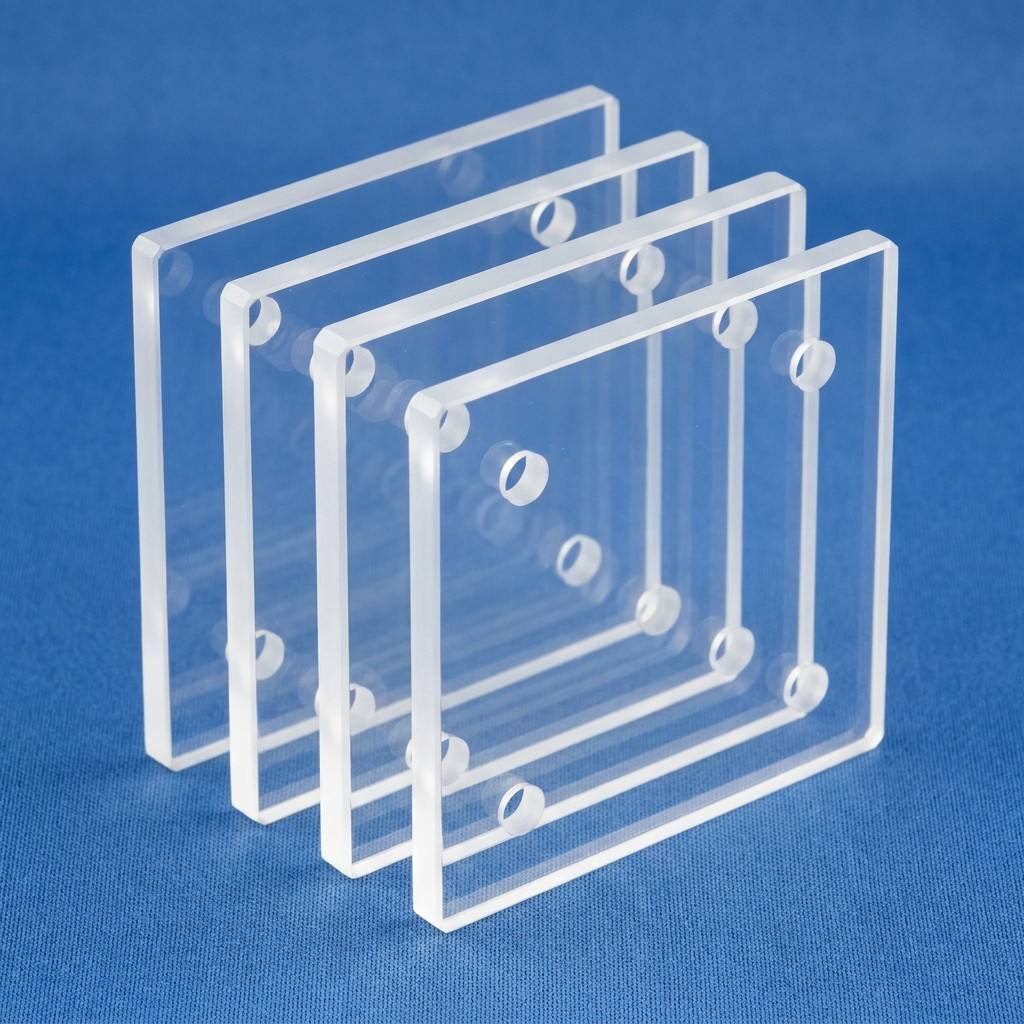
- Precision-polished observation windows and multi-port optical access nozzles custom-welded to vessel walls.
2. Pharmaceutical Synthesis & API Development
Szeged has long been celebrated for medical discoveries (such as Albert Szent-Györgyi's isolation of Vitamin C). Today, SZTE's Department of Pharmaceutical Chemistry and local pharma innovators require flawless reaction flasks:
- Zero trace metal contamination (≤20 ppm total) guarantees no catalyst poisoning in organometallic coupling reactions.
- Multi-neck Schlenk quartz flasks for moisture- and oxygen-sensitive pharmaceutical precursor synthesis.
- Ground standard tapers (NS 14/23, NS 29/32) engineered to maintain airtight vacuum integrity during continuous distillation.
3. Thermal Acid Digestion & Analytical Chemistry
For trace elemental determination using ICP-MS and AAS in environmental monitoring and mineral analysis around the Southern Great Plain:
- Kjeldahl digestion flasks capable of handling boiling concentrated sulfuric, nitric, and perchloric acids without glass degradation.
- Thermal tolerance allows rapid transition from heating blocks to cooling water baths without cracking.
- Eliminates background boron, sodium, and silicon contamination inherent to traditional borosilicate vessels.
4. Solar Cell & Photovoltaic Materials Pilot Lines
With Hungary's substantial national investments in renewable energy and the expansion of solar component testing in Szeged's Science Park:
- Quartz evaporation vessels and sublimation flasks for high-purity thin-film perovskite and silicon precursor purification.
- High thermal stability under reduced pressure prevents flask collapse during chemical vapor deposition (CVD) vapor feed stages.
- Compatible with custom quartz manifolds, gas bubblers, and vacuum collection traps.
5. Tisza Basin Environmental Hydrology & Soil Monitoring
Szeged sits at the convergence of vital waterways subject to agricultural and industrial run-off studies. Municipal environmental bureaus and university geology researchers deploy VEZLO quartz flasks for pesticide residue extraction, high-temperature sample combustion, and organic pollutant Soxhlet extraction protocols, where completely inert glassware surfaces are mandatory to prevent analytical bias.
Local Market Development Trends in the Szeged Science & Technology Corridor
Understanding Szeged's growth vector is essential for institutional procurement planning. Over the next five years, four macroscopic industrial and academic trends will directly stimulate the demand for specialized fused quartz laboratory apparatus:
1. Expansion of the Szeged Science Park (Rheinmetall & BYD Ecosystems): The development of the 85-hectare Science Park adjacent to ELI-ALPS is attracting high-tech industrial partners in electromobility, advanced materials, and defence photonics. High-precision quartz distillation flasks and chemical synthesis reactors are transitioning from purely academic bench-scale units to continuous industrial quality-assurance pilot lines.
2. Deepening Horizon Europe & LaserLab-Europe Collaborations: As ELI-ALPS hosts greater cohorts of international visiting scientists under European Union framework grants, experimental setups require bespoke quartz glassware that conforms strictly to international DIN EN ISO standards. This requires suppliers to provide certified 3D CAD modeling, custom ground joints, and documented raw material spectral certificates.
3. Regional Green Chemistry & Sustainable Biomass Extraction: Research at the University of Szeged is increasingly focusing on supercritical fluid chemistry, hydrothermal carbonization, and catalytic pyrolysis of agricultural by-products from the Hungarian Great Plain. These methodologies subject reaction vessels to temperatures over 800°C alongside severe organic vapor pressures, driving substitution away from metallic autoclaves toward transparent, non-reactive fused silica chambers.
4. Cross-Border Industrial Clusters (Hungary-Serbia-Romania Triangle): Szeged's geostrategic position near the Serbian and Romanian borders positions it as a centralized laboratory testing hub for regional agricultural, chemical, and pharmaceutical exports. Centralized procurement teams increasingly consolidate orders with factory-direct manufacturers capable of supplying certified batch-to-batch consistency.
Why Hungarian Researchers & Importers Source from VEZLO
Integrated manufacturing superiority rooted in Donghai County, China—combining raw material refinement with precision flame-working craftsmanship.
Primary Source Purity
Operating a 33,000 m² (50-mu) production facility in Donghai, we control the entire lifecycle from raw sand purification (≤20 ppm metals across 13 specialized grades) to finished glassblowing, eliminating foreign inclusions and structural micro-bubbles.
Provincial R&D Recognition
Honored as a Jiangsu Provincial Science & Technology Support Project for our 320 mm high-purity semiconductor tubes, with 520 mm large-diameter tubes passing national new product preliminary reviews. We commit over RMB 5M annually to quartz engineering innovation.
Custom OEM/ODM to Drawing
From micro-reaction flasks (10 ml) to heavy-wall industrial boiling vessels (20,000 ml), we produce to exact CAD blueprints. We offer precision optical window welding, standard taper joints, stopcocks, threaded GL ports, and multi-neck configurations.
Export Packing & Fast Transit
Each quartz flask is wrapped in shock-absorbing EPE multi-layer foam, vacuum-sealed against moisture, and crated in fumigation-free wooden export cases. We ensure fast air-freight transit to Budapest Ferenc Liszt International Airport (BUD) with direct regional delivery to Szeged.
Frequently Asked Questions for Szeged Sourcing Managers
Clear, authoritative answers addressing technical specifications, logistics to Hungary, EU customs clearance, and quality assurance.