Featured Quartz Glass Substrates & Custom Components
Factory-direct optical plates, semiconductor wafer discs, clear fused tubes, and CNC precision-milled substrates manufactured from raw crystal batches with conventional metallic impurities ≤20 ppm.
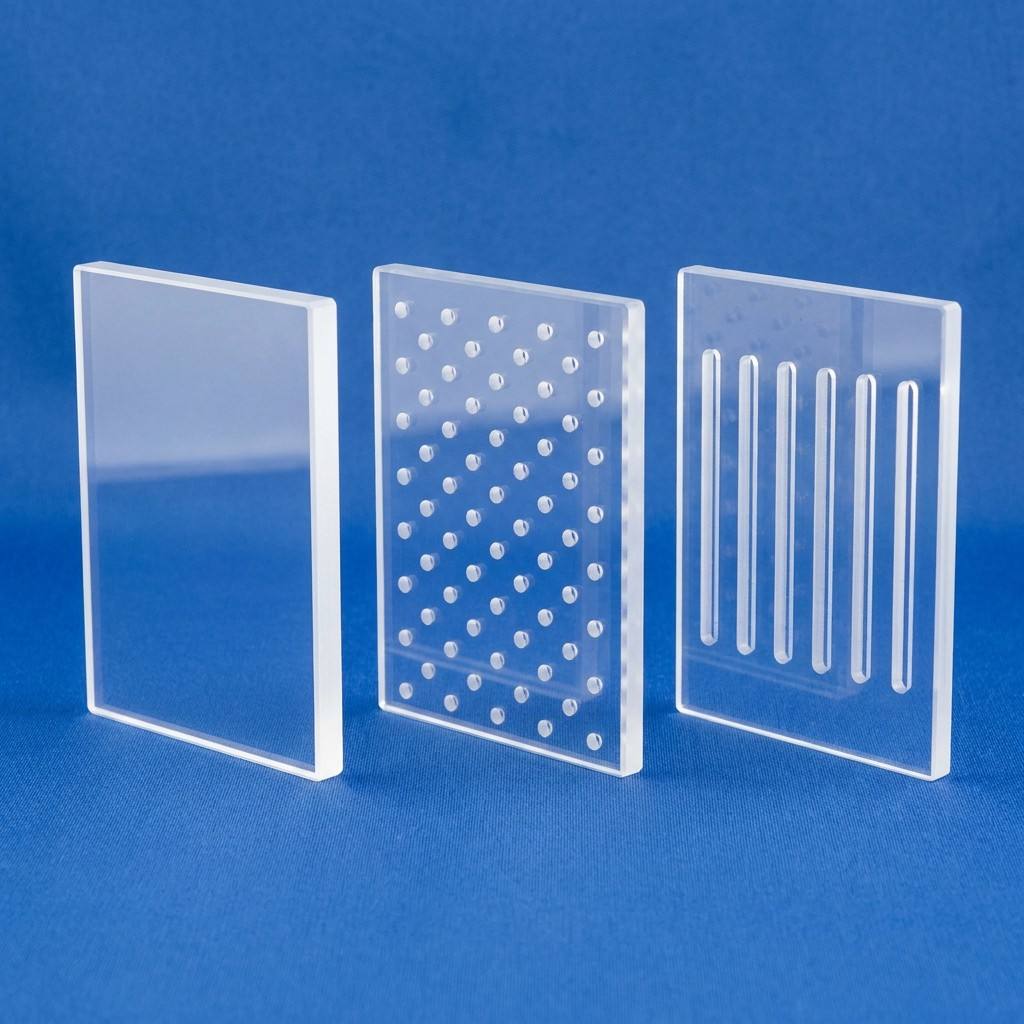
Drilled Quartz Plate Multi Hole Fused Silica CNC Machined Custom
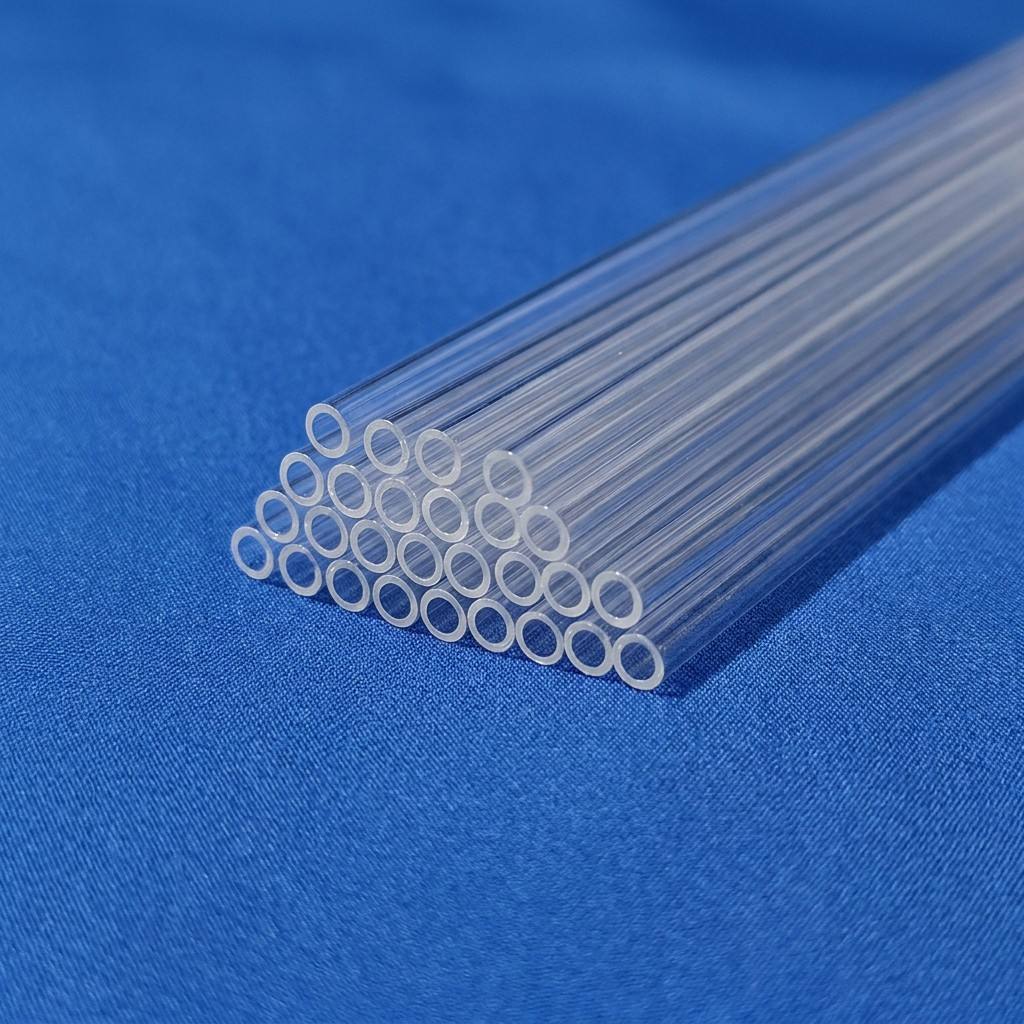
Quartz Glass Tube Raw Stock Clear Fused Silica Transparent Pipe Blank

Semiconductor Quartz Plate Fused Silica Substrate High Purity Custom
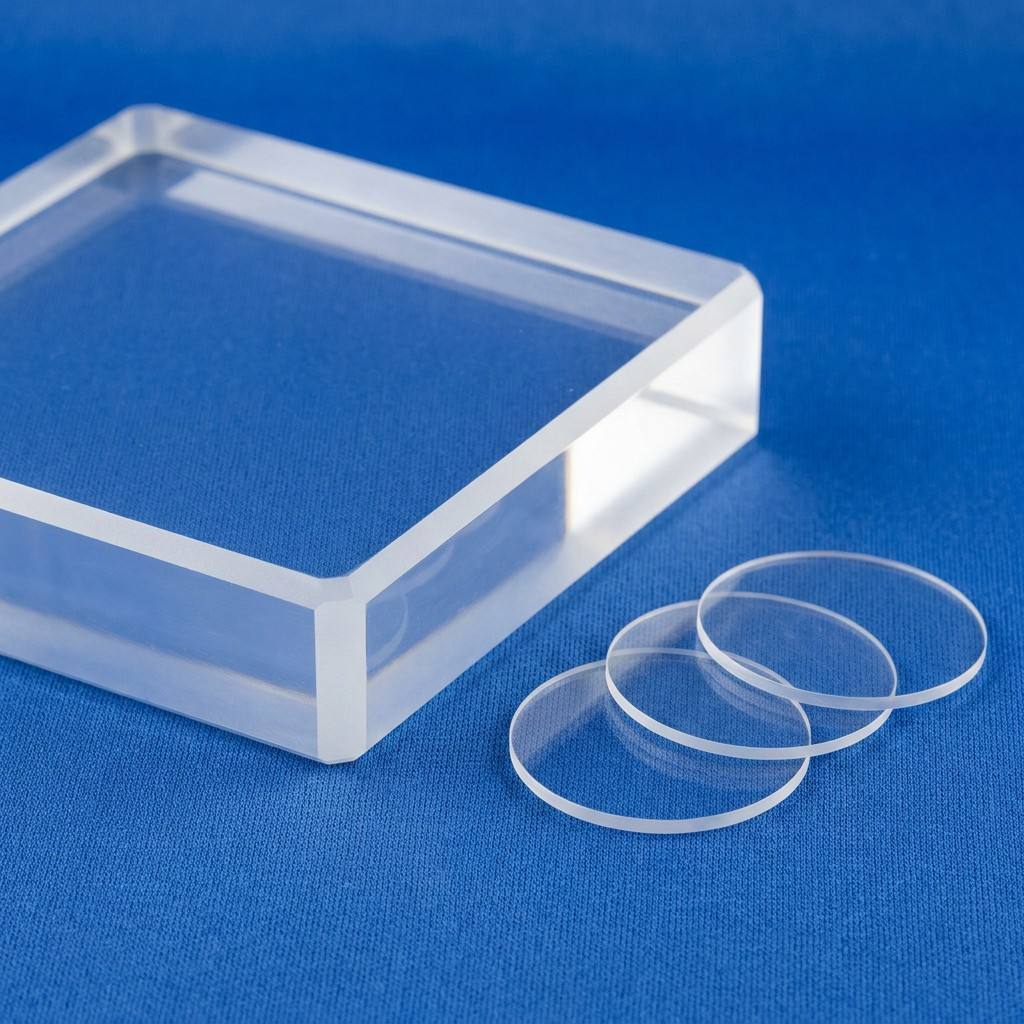
Quartz Plate for Laboratory Fused Silica Clear Heat Resistant Custom

Quartz Plate 100x100mm 200x200mm Fused Silica Clear Custom Cut
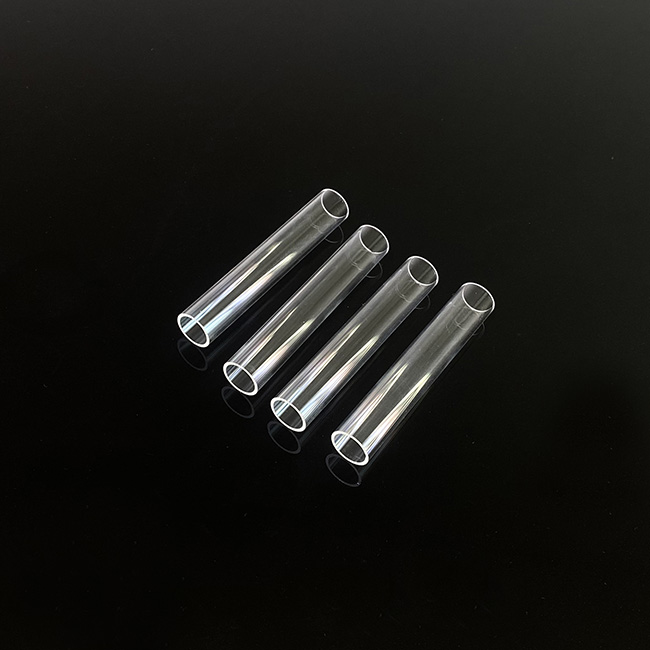
Large Diameter Clear Quartz Borosilicate Glass Tube Round Pipe

Quartz Plate 3mm 5mm 8mm Thickness High Purity Fused Silica Polished

Quartz Substrate Plate for Semiconductor Fused Silica Clear Polished
Morphology, Metrology & Thin-Film Mechanics of Quartz Substrates
Understanding why high-purity amorphous silicon dioxide (SiO²) is the indispensable foundational layer for micro-electromechanical systems (MEMS), high-temperature wafer processing, and deep-UV spectroscopy.
Thermal Shock & Ultra-Low CTE
Unlike soda-lime or standard borosilicate float glasses that warp or shatter under sudden temperature spikes, fused quartz exhibits an extraordinarily low Coefficient of Thermal Expansion (CTE) of 5.5 × 10−&sup7; / °C between 20°C and 320°C.
This molecular matrix stability enables quartz glass substrates to undergo continuous operating cycles at 1,100°C and withstand brief thermal peaks approaching 1,300°C without volumetric deformation or micro-fracturing.
Deep-UV to IR Spectral Transmission
For demanding optical and lithography applications, synthetic and natural high-purity fused silica substrates offer unmatched transmission across the electromagnetic spectrum, spanning from deep ultraviolet (185 nm) through visible up to near-infrared (2,500 nm).
High transmission is preserved via strict controls on metallic contaminants (Fe, Ti, Al) and low hydroxyl (OH−) doping, eliminating absorption bands and laser degradation during intense optical irradiation.
Chemical Inertness & Dielectric Rigidity
Quartz substrates demonstrate total chemical inertness against almost all organic and mineral acids, including boiling hydrochloric (HCl), sulfuric (H²SO&sup4;), and nitric acid (HNO³), responding vulnerably only to hydrofluoric acid (HF) and concentrated hot phosphoric acid.
With a dielectric constant of 3.8 at 1 MHz and dissipation factor < 0.0001, it is the premier substrate for microwave integrated circuits and high-frequency communication modules.
Precision Quartz Substrate Applications in Denpasar & Indonesia
How advanced clean-technology projects, marine scientific institutes, university research labs, and industrial automation facilities in Denpasar leverage high-spec fused silica glass.
1. Marine In-Situ Photonics & Oceanographic Biosensing
Denpasar, acting as the maritime research gateway to the Coral Triangle and Indonesian archipelago, hosts advanced oceanographic sensing research under partnerships with entities like Universitas Udayana (UNUD) and regional marine conservation projects.
Field-deployed spectrometers, submersible fluorometers, and underwater multi-spectral cameras require optical quartz substrates that do not pit, leach sodium ions, or suffer salt-induced solarization when continuously exposed to high-salinity sea environments under aggressive tropical sunlight. Our precision polished quartz plates serve as pressure-tight viewports and laser excitation windows down to 500-meter marine depth ratings.
2. Next-Gen Photovoltaic (PV) & Perovskite Solar Cell Research
As Indonesia accelerates its national energy transition (Net Zero Emission 2060), Bali has emerged as a premier testing corridor for decentralized solar microgrids and building-integrated photovoltaics (BIPV). Academic cleanrooms in the Denpasar agglomeration rely on fused silica substrates for spin-coating perovskite and thin-film tandem solar formulations.
The complete absence of alkali-metal diffusion—common in cheap soda-lime substrates—prevents electrical pinhole short-circuits during high-temperature annealing at 500°C, dramatically stabilizing conversion efficiency measurements for experimental solar cells.
3. Industrial UV-C Sanitization & Municipal Water Purification
Denpasar’s sprawling hospitality, food processing, and public municipal infrastructure depend heavily on non-chemical water sterilization systems. Municipal water projects across Bali integrate closed-loop UV-C disinfection modules.
Unlike low-grade glass sleeves that cloud within months under continuous germicidal radiation, our synthetic fused silica and ozone-free quartz tubes provide >90% transmission at 254 nm. This optical clarity eliminates microbial pathogens, prevents biofilm accumulation, and sustains lamp operating lifespans past 12,000 continuous hours in tropical ambient temperatures.
4. Microfluidic Lab-on-a-Chip & Environmental Analytics
Decentralized water quality screening across Bali's rivers and coastal wetlands utilizes microfluidic diagnostic chips fabricated on CNC-drilled, multi-hole quartz plates. Multi-channel laser-etched quartz glass substrates enable real-time detection of heavy metals and pesticide runoffs.
The isotropic chemical etching properties and autofluorescence-free background of fused silica guarantee that high-speed laser analytical assays yield zero background noise during fluorescence spectrometry.
Technical Comparison: Fused Quartz vs. Standard Borosilicate Float Glass
Precise physical, mechanical, thermal, and optical metrics evaluated under ISO 9001 and SEMI fabrication protocols.
| Physical / Chemical Property | High-Purity Fused Quartz Substrate | Technical Borosilicate Glass 3.3 | Engineering Impact for Local Buyers |
|---|---|---|---|
| Chemical Composition (SiO²) | ≥ 99.99% Amorphous Silica | ~ 81.0% SiO² + 13% B²O³ + Alkali | Zero ionic migration; absolute vacuum & cleanroom safety |
| Thermal Expansion Coeff. (CTE) | 5.5 × 10−&sup7; / °C | 3.3 × 10−&sup6; / °C | 6x higher thermal shock resistance; zero spatial warpage |
| Maximum Continuous Temp | 1,100 °C (Softening point 1,683 °C) | 500 °C (Softening point 820 °C) | Withstands semiconductor diffusion & chemical vapour deposition |
| UV Cutoff Wavelength | < 185 nm (Deep UV-C Transparent) | ~ 310 nm (Blocks UV-C / Short-Wave UV) | Critical for photochemical reactors, lithography, & UV sensors |
| Surface Micro-Roughness (Ra) | ≤ 0.5 nm (Super-Polished CMP) | ~ 1.5 - 3.0 nm (Standard Float) | Ensures high-adhesion thin-film sputtering without pinholes |
| Total Thickness Variation (TTV) | ≤ 1.5 μm across 100mm span | ≤ 10 μm across 100mm span | Eliminates focal drift in laser optics and wafer aligners |
| Dielectric Breakdown Field | 25 - 40 kV/mm | 15 - 20 kV/mm | Extreme insulation for high-voltage MEMS and RF chips |
Technological & Procurement Trajectories in Bali & Regional Indonesia
Strategic shifts in the Southeast Asian high-tech ecosystem shaping the consumption of specialized fused silica glass substrates.
Decentralized Cleanroom Labs & Tech Hubs
Indonesia’s strategic drive to expand localized technological capability under "Making Indonesia 4.0" is decentralizing specialized laboratory research beyond Java into Bali. Denpasar is emerging as a regional centre for environmental analytics, clean-tech research, and marine data sensing.
This shift drives growing demand for rapid-turnaround custom quartz substrate orders (100x100mm, 200x200mm blanks, micro-machined disc arrays) tailored to agile research budgets rather than multi-ton commercial foundry runs.
Rigorous Traceability & Material Purity Demands
Engineering procurement officers across Indonesia increasingly reject non-certified commercial quartz containing unknown ppm concentrations of trace aluminium (Al), sodium (Na), and iron (Fe).
Buyers targeting mission-critical optical transmission and high-temperature furnaces mandate mill-test certificates, GDMS (Glow Discharge Mass Spectrometry) impurity verification, and ISO-standard surface flatness profiles directly from the manufacturer.
Tropical Supply-Chain Hardening
Denpasar’s tropical coastal climate introduces severe logistics challenges: elevated humidity (>85% RH) and airborne maritime salinity can degrade standard optical packaging, inducing moisture haze or chemical fogging on freshly polished glass surfaces during cargo handling.
Suppliers must provide sealed multi-layer vacuum foil packing, desiccant charges, and vibration-proof shock protection specifically engineered for air transit into Ngurah Rai (DPS) or sea container offloading at Benoa Harbour.
Frequently Asked Questions by Technical Buyers Serving Denpasar
Addressing material performance, dimensional tolerances, shipping logistics, customs documentation, and localized deployment challenges.
Fused quartz is produced by high-temperature electric arc melting of ultra-pure natural quartz crystal sand (≥99.99% SiO²). It offers exceptional thermal stability and mechanical rigidity at an economical cost for furnace tubes, standard substrates, and labware. Synthetic fused silica is synthesized via chemical vapor deposition using silicon precursors (SiCl&sup4;), achieving ultra-trace metallic impurities (<1 ppm) and superior deep-UV transmission down to 185 nm without solarization.
Every polished quartz substrate is cleaned via automated ultrasonic deionized water lines, shrink-wrapped in cleanroom dust-free static bags, and separated by non-abrasive optical lens paper. Multiple substrates are nested inside custom high-density pearl cotton inserts within reinforced dual-wall cartons and crated in fumigation-free ISPM-15 plywood export boxes designed to absorb multi-axis transport vibration during air freight or sea shipping.
Utilizing 5-axis ultrasonic CNC diamond machining centers, we routinely achieve outer diameter and edge dimension tolerances within ±0.05 mm, hole pitch and hole diameter tolerances down to ±0.02 mm, and polished substrate thickness tolerances within ±0.01 mm. Edge profiles can be chamfered, ground, or fire-polished to prevent edge-chipping during cleanroom vacuum handling.
For express prototypes and urgent research consumables, door-to-door air freight via DHL/FedEx arrives at I Gusti Ngurah Rai International Airport (DPS) within 4 to 6 business days from export clearance. For heavy bulk orders (large diameter quartz tubes, thick plate pallets), ocean freight ships via Tanjung Perak (Surabaya) or directly to Port of Benoa (Denpasar) with transit times averaging 14 to 20 days.
Yes. We manufacture titanium-doped ozone-free quartz glass that selectively absorbs the 185 nm ozone-generating wavelength while maintaining high transmittance (>88%) at the critical 254 nm germicidal line. This is ideal for water treatment, aquaculture operations, and air purification facilities throughout Bali where atmospheric ozone accumulation in enclosed operator rooms is strictly restricted.
Unlike alkali-rich float glass that suffers from surface sodium leaching, hydrolysis, and glass disease under high humidity, high-purity fused silica is structurally inert. Its pure Si-O-Si cross-linked framework does not develop white salt hazing or pitting corrosion when deployed in marine spectrometers or tropical cleanrooms, ensuring decade-long optical calibration integrity.
VEZLO Quartz: Industrial Capability & Strategic Heritage
Operating from a 50-mu (≈33,000 m²) facility in Donghai County—the globally renowned capital of high-purity natural silica—VEZLO Quartz combines complete raw-material control with advanced cold-machining, laser dicing, and thermal flame-working.
Donghai Industrial Cluster
Integrated sourcing from world-class natural quartz deposits guarantees rock-bottom raw material latency, raw crystal sand with total impurities ≤20 ppm, and unmatched cost-performance for global buyers.
Government-Backed R&D
Developers of the 320 mm high-purity quartz tube for integrated circuits under the Jiangsu Provincial Science & Technology Project, and innovators behind large-diameter 520 mm diffusion furnace components.
Rapid Technical Support
Direct communication with quartz manufacturing engineers. We deliver drawing review, technical feasibility feedback, and formalized commercial quotations in under 2 hours, sustaining a 50% repeat-order rate.
Precision Finishing Suite
Equipped with computerized slicing, dual-side planetary lapping, CMP chemical mechanical polishing, ultrasonic drilling, and Class 100 cleanroom packaging lines to satisfy SEMI-standard purity guidelines.
Ready to Source High-Purity Quartz Substrates for Your Denpasar Project?
Send us your engineering drawings, required dimensional tolerances, surface roughness parameters, and spectral transmission specifications for rapid, expert evaluation.
Contact Us